
Aadhaar Offline Verification:
The Identity Shift BFSI & Fintech Cannot Ignore
Billions of Aadhaar photocopies sit in filing cabinets with no cryptographic assurance, no consent trail, and no audit path. UIDAI’s new OVSE framework closes this gap — and the window to act is right now.
I’m Lokesh Chaudhary, Founder and CEO, KYCKART. Last month I was in a room full of compliance and onboarding heads at a BFSI roundtable in Mumbai. The conversation was about fraud vectors.
A veteran from a large private bank said something that stopped the room cold: “Our biggest KYC vulnerability isn’t deepfakes or synthetic identities. It’s the photocopy of an Aadhaar card sitting in a filing cabinet somewhere.”
He was right. Across India’s banking and fintech landscape, billions of Aadhaarphotocopies have been collected, stored, and forgotten. They carry no cryptographic assurance and no consent trail, and nobody can audit whether the data has been repurposed or leaked.
UIDAI has been quietly building the answer to this problem for years. In January 2026, it crystallised into a full-fledged Aadhaar Offline Verification framework. The framework is backed by:
- The newly launched Aadhaar App.
- Verifiable Credentials.
- A formal registration regime for Offline Verification Seeking Entities (OVSEs).
This edition of KYCKART Intel covers what this means for BFSI and Fintech, and why the window to act is right now.
Understanding the Shift
Online authentication vs. offline verification — a fundamental architecture change
Traditional Aadhaar-based KYC relied on online authentication. That is a real-time call to UIDAI’s Central Identities Data Repository (CIDR). It often requires biometrics and full Aadhaar number handling. Aadhaar Offline Verification takes a different route.
The customer shares digitally signed Aadhaar data directly with the verifier. There is no call to CIDR. No biometrics are required. No full Aadhaar number is transmitted. The verifier (registered as an OVSE[9]) validates UIDAI’s cryptographic signature locally. This confirms authenticity and data integrity without touching the central database.
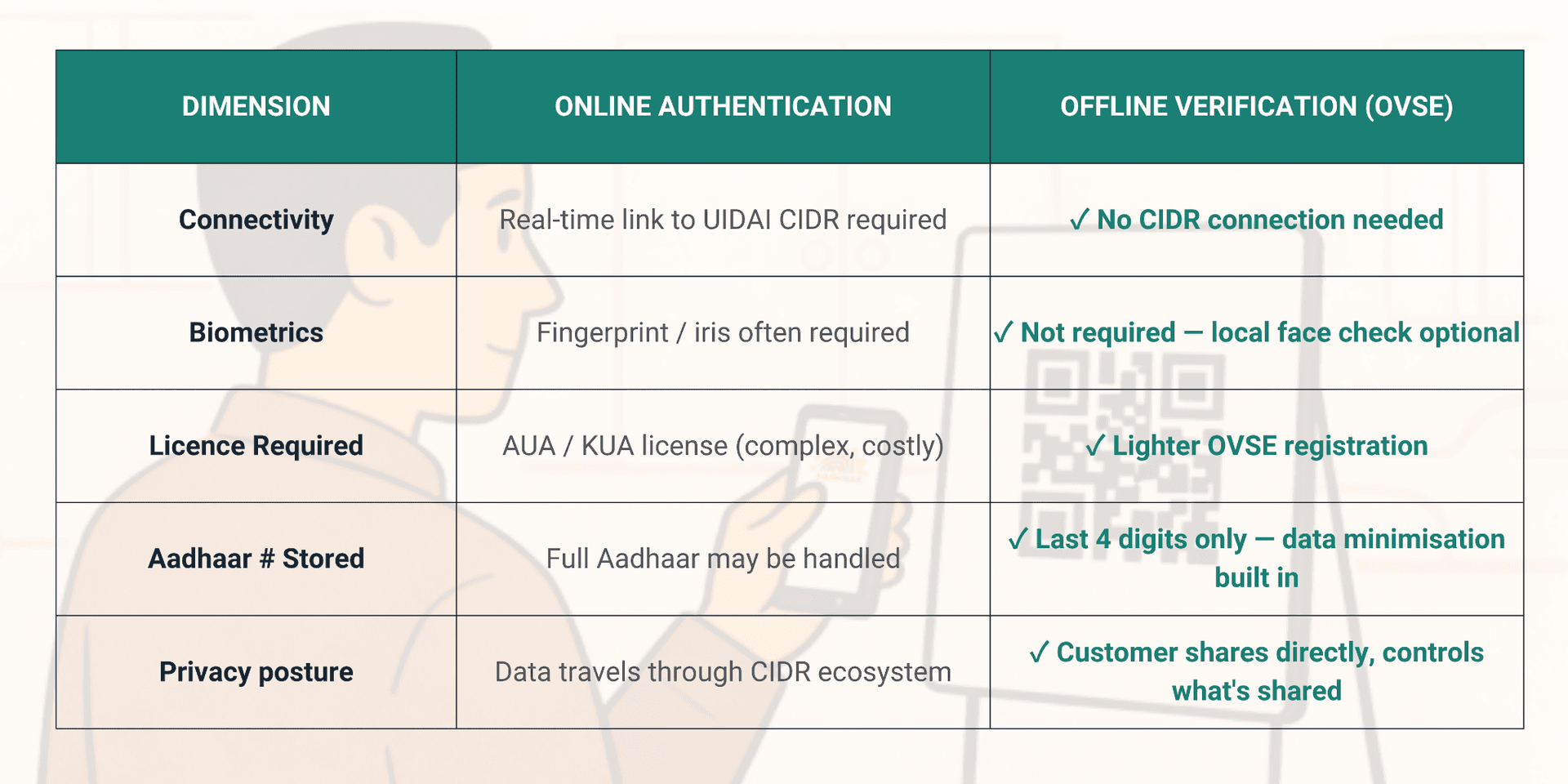
Source: UIDAI OVSE Handbook · January 2026 — Online Authentication vs. Offline Verification (OVSE) across five key dimensions
“The photocopy era of Aadhaar KYC is over. Consent-driven, cryptographically signed offline verification is the new standard — and it's available today.”
4 Methods Every Team Should Know
UIDAI's January 2026 handbook — four offline verification pathways
Each pathway has a different assurance level, technical footprint, and use-case fit. Teams building onboarding or re-KYC flows should understand the trade-offs:
The customer presents their Aadhaar (physical card, e-Aadhaar, mAadhaar, or new Aadhaar App). The OVSE scans the QR and validates UIDAI's digital signature locally. Output is display-only, with no savable data. This is the lowest-friction method.
The customer downloads a digitally signed, password-protected XML file from UIDAI's portal via mAadhaar. It contains name, address, photo, gender, DOB, and hashed mobile/email. Registered OVSEs can save it. It suits lending and account opening workflows.
The digitally signed, password-protected PDF version of the Aadhaar letter. It is legally equivalent to the physical card. OVSEs validate the embedded UIDAI digital signature or scan the QR within it. It is familiar to customers already using e-Aadhaar.
The most advanced method. It is issued via the new Aadhaar App (launched 2026). The credential is stored on the customer's phone. It supports selective attribute sharing, so the customer shares only what's needed for the transaction. It includes optional offline face verification for proof-of-presence and seamless app-to-app or web-to-app flows.
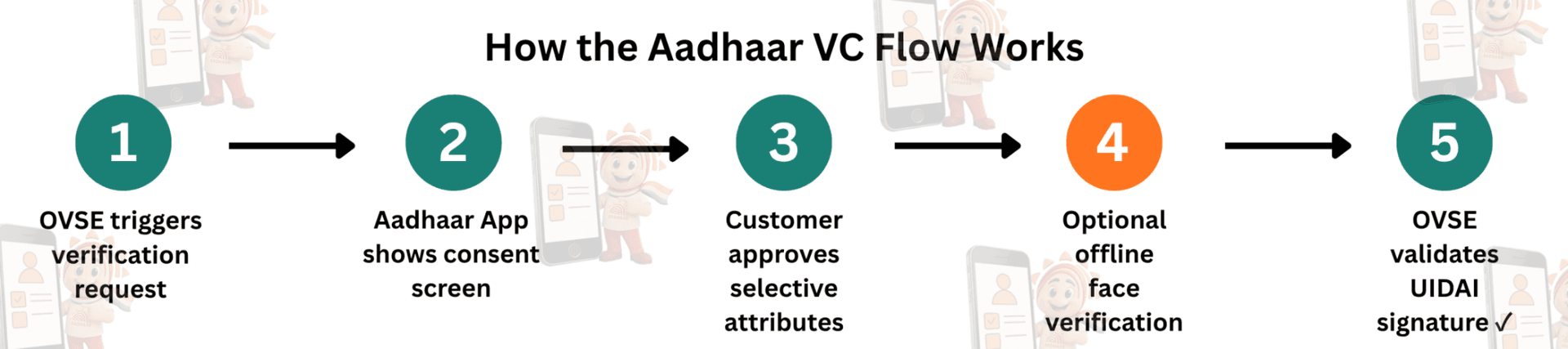
How the Aadhaar VC Flow Works — end-to-end in under 30 seconds via app-to-app or web-to-app intent
BFSI & Fintech: Where OVSE Delivers the Most Value
Four use cases with the deepest operational transformation potential
While UIDAI’s handbook covers hospitality, healthcare, real estate, and gig platforms, the deepest operational value sits squarely in financial services. These four use cases will see the most immediate impact:
Replace OCR-on-photocopy flows with Aadhaar VC–based onboarding. A single Aadhaar App consent journey delivers digitally signed demographics, a verified photograph, and face-match proof-of-presence. There is no scanner, no manual entry, and no photocopy stored.
Fintechs building PPI wallets, co-branded cards, or savings products can plug in OVSE flows via web-to-app intent. The customer starts on the portal, approves in the Aadhaar App, and returns with a signed VC in under 30 seconds. Periodic re-KYC becomes equally frictionless with a fresh timestamped VC.
Field agents need to confirm they're engaging the right borrower, even offline. OVSE-enabled QR verification lets agents validate the UIDAI signature on-device. They can log a timestamped, consent-backed proof-of-interaction. This creates an auditable contact chain that holds up under regulatory scrutiny.
At cashless claim desks, OVSE flows verify patient identity via Aadhaar VC. No full Aadhaar number is stored, consent is logged, and optional face verification blocks proxy claims. This is a meaningful control for health insurers carrying ₹2,000+ crore in annual fraud exposure.
OVSE, DPDP & The Compliance Dividend
How offline verification is structurally aligned with India's data protection law
India’s Digital Personal Data Protection (DPDP) Act, 2023[10] places explicit obligations on data fiduciaries around consent, data minimisation, purpose limitation, and accountability. These aren’t abstract principles. They’re enforcement levers. Aadhaar offline verification is structurally aligned with every one of them.
Consider what OVSE mandates by design:
Explicit Consent
Consent request initiated by OVSE, presented via Aadhaar App, explicitly approved by customer before any data flows.
Data Minimisation
Only the minimum attributes needed for the stated purpose are requested and shared. Selective disclosure is built in.
No Full Aadhaar Stored
The full 12-digit Aadhaar number is never transmitted or stored by the OVSE. Only the last 4 digits are kept.
Consent Logs Maintained
Every verification event generates a timestamped, auditable consent log. This is the evidentiary trail DPDP enforcement requires.
Post-Verification Notice
Customer receives notification after each verification, maintaining transparency about who accessed their identity data.
Key Insight: UIDAI’s own OVSE compliance checklist references the Aadhaar Act[11], IT Act[12], and DPDP Act explicitly. That makes OVSE registration more than identity hygiene: it is a legally defensible data trail in an era when regulators will demand one.
Frequently Asked Questions
KYCKART Intelligence
Ready to replace photocopies
with cryptographic assurance?
KYCKART’s OVSE-integrated identity flows give your team consent-backed, digitally signed Aadhaar verification. You get zero photocopies, full DPDP compliance, and a complete audit trail.
Talk to a Risk Expertarrow_forward