
Bank Statement Fraud
Is Up 40%. Is Your Stack
Built to Stop It?
The extraction layer has matured. The authenticity layer has been treated as an afterthought. And fraudsters have noticed — with AI-generated fake statements surging 180% in FY2025 alone.
I’m Lokesh Chaudhary, Founder and CEO, KYCKART.
A few weeks ago, I sat across from the head of credit risk at a mid-sized NBFC in Delhi, and heard something that has been on my mind since.
They had just discovered that a borrower who had sailed through their digital onboarding with a clean bank statement had submitted an edited PDF. Six months of salary credits had been quietly inserted using a free PDF editor.
The loan had already been disbursed. The EMI had already bounced.
What struck me was not the fraud itself — we see variants of this every week at KYCKART[1]. What struck me was the credit officer’s admission: “Our system extracted the data perfectly. It just never questioned whether the document was real.”
This is the central paradox of bank statement analysis[2] in India in 2026.
The extraction layer has matured enormously:
- OCR accuracy.
- Transaction categorisation.
- Income estimation.
- EMI detection.
But the authenticity layer, the foundational question of whether the document in front of you is genuine, has been treated as an afterthought. And fraudsters have noticed.
Scale of the Problem
Document manipulation — the fastest-growing fraud vector in Indian digital lending
India’s digital lending ecosystem disbursed over ₹1.8 lakh crore in personal and MSME loans through digital channels in FY2025.
Bank statements are the primary income and cash-flow verification document in the overwhelming majority of these journeys.
That makes bank statement fraud not a niche compliance problem. It is a systemic risk embedded in the core of India’s credit infrastructure.
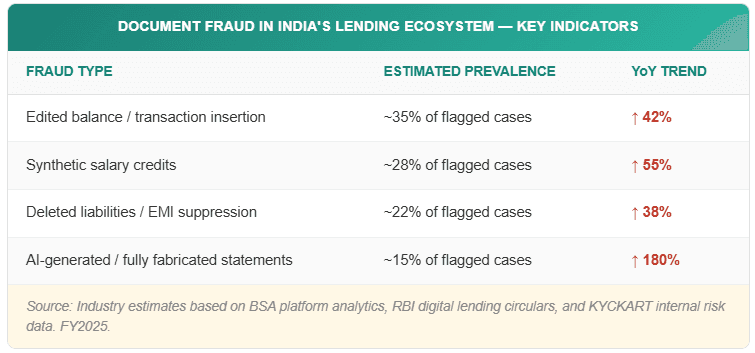
Source: Industry estimates based on BSA platform analytics, RBI digital lending circulars, and KYCKART internal risk data · FY2025
AI-Generated Fakes
+180%
Fully fabricated statements (not edits) — the fastest-growing sub-category
Industry estimates · FY2025
Edited Balance / TXN
35%
Largest share of flagged cases — balance and transaction insertion
BSA platform analytics
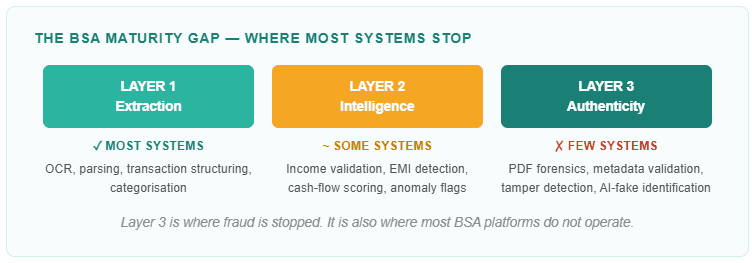
Layer 3 is where fraud is stopped. It is also where most BSA platforms do not operate.
“A bank statement that extracts cleanly but was never real is not an asset — it is a liability you haven't discovered yet.”
How Bank Statement Tampering Actually Works
Know the attack vectors — a fraud team that knows exactly what to look for is 10× more effective
Understanding tamper methods is not academic — it is operationally essential. Here is how the four most common manipulation patterns work in practice, and what detection signals they produce:
PDF Layer Editing
Modified PDFs contain tell-tale signs: mismatched font metrics, altered creation/modification timestamps, inconsistent producer metadata, additional objects not present in genuine bank templates, and balance-chain breaks where the running balance arithmetic no longer adds up after tampering.
Print-Scan-Edit Cycles
Pixel-level font inconsistency analysis, character spacing anomalies, and scan-quality irregularities flag the altered areas (which often have different resolution or compression artefacts). Missing digital signature structures expected in native bank PDFs are a strong secondary signal.
Synthetic Salary Injection
Behavioural anomaly detection is highly effective: real salaries vary slightly month-to-month, have occasional TDS deductions, coincide with provident fund debits, and show payroll-adjacent patterns. Perfectly regular, round-figure, zero-variance salary credits are a strong fraud signal. Metadata inspection also flags the insertion.
New Liability Suppression
Balance-chain validation is highly effective — if transactions are deleted, the running balance arithmetic fails at the deletion point. Cross-referencing against bureau data (declared loan obligations vs. visible EMI debits in the statement) surfaces discrepancies. Multiple-account consolidation can expose hidden liabilities flowing through secondary accounts.
The New Frontier: AI-Generated Fake Statements
Not edited documents — entirely synthetic PDFs fabricated from scratch
If edited PDFs are the 2020 fraud problem, AI-generated bank statements are the 2026 crisis in formation[4].
We are now seeing fully fabricated bank statement PDFs. These are not edited versions of real documents, but entirely synthetic documents generated using AI tools, template engines, and large language models[3].
These grew by 180% in reported FY2025 cases. The actual numbers are far higher, because most lenders lack the forensic tooling to identify them at all.
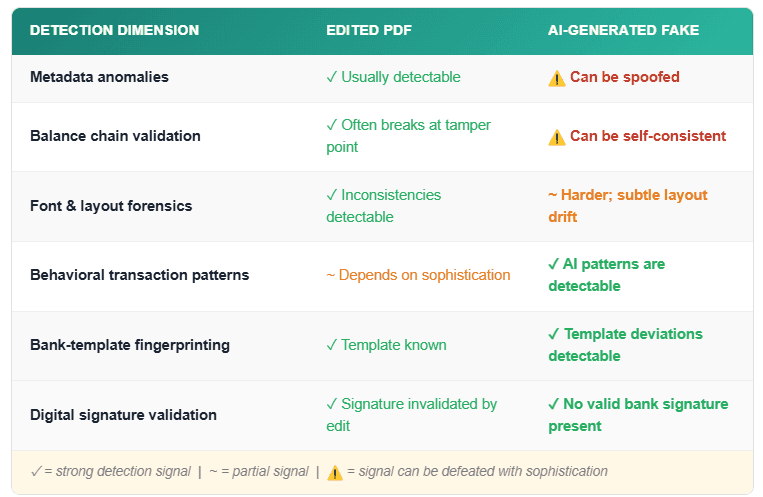
✓ = strong detection signal | ~ = partial signal | ⚠ = signal can be defeated with sophistication
Key Insight: AI-generated fakes are actually more consistently detectable through behavioral transaction pattern analysis and bank-template fingerprintingthan edited PDFs. This holds only if those detection layers are present in your BSA stack. Most aren’t.
What Good BSA Looks Like in 2026
A mature BSA capability is a layered stack — not a single tool
Here is the evaluation framework KYCKART recommends for any BFSI organisation building or upgrading their Bank Statement Analysis capability:
Extraction
Most systems- chevron_rightOCR parsing
- chevron_rightTransaction structuring
- chevron_rightCategorisation
Intelligence
Some systems- chevron_rightIncome validation
- chevron_rightEMI detection
- chevron_rightCash-flow scoring
- chevron_rightAnomaly flags
Authenticity
Few systems- chevron_rightPDF forensics
- chevron_rightMetadata validation
- chevron_rightTamper detection
- chevron_rightAI-fake identification
Layer 3 is where fraud is stopped. It is also where most BSA platforms do not operate.
Authenticity First, Analytics Second
Run document forensics — metadata inspection, digital signature validation, balance-chain verification, font anomaly checks — before the analytics layer runs. There is no value in generating an income estimate from a tampered document. Authenticity is the gate; analytics is the output.
Behavioural Anomaly Layer for AI-Generated Fakes
Static rule-based fraud detection is necessary but insufficient. A machine learning behavioural layer trained on real Indian bank account patterns is required to catch AI-generated fakes. Key signals: transaction timing distribution, merchant diversity curves, micro-pattern irregularities, and absence of real-world friction events.
Multi-Account Consolidation with Cross-Account Fraud Checks
Sophisticated borrowers submit multiple bank accounts, hoping that liability suppression in one won't be caught against another. A consolidated view with deduplication and cross-account consistency checks is essential — hidden liabilities often surface only when accounts are reviewed together.
Bureau Cross-Reference for Liability Validation[6]
Active loan obligations appearing in bureau data but absent from the bank statement are one of the clearest fraud signals available. Every BSA workflow should include a bureau cross-reference step: declared or detected EMI debits in the statement vs. reported outstanding credit obligations in bureau data.
AA-First with Hardened PDF Fallback
Design the onboarding journey to route through Account Aggregator where possible, with the PDF forensics layer as a fallback for cases where AA is unavailable. Critically, the PDF fallback should trigger the full forensics stack — fallback cases are inherently higher risk and must not receive a lighter process.
Frequently Asked Questions
KYCKART Intelligence
Does your BSA stack reach
Layer 3?
KYCKART’s Bank Statement Analysis goes beyond extraction — with balance-chain forensics, AI-fake detection, multi-account consolidation, and bureau cross-referencing built in from the start.
Talk to a Risk Expertarrow_forward