
PAN, Video KYC, and Identity Verification Under RBI’s Digital Lending Rules
What identity verification requires under RBI digital lending rules. Learn Aadhaar-OTP limits, Video KYC rules, and PAN checks across the loan lifecycle.
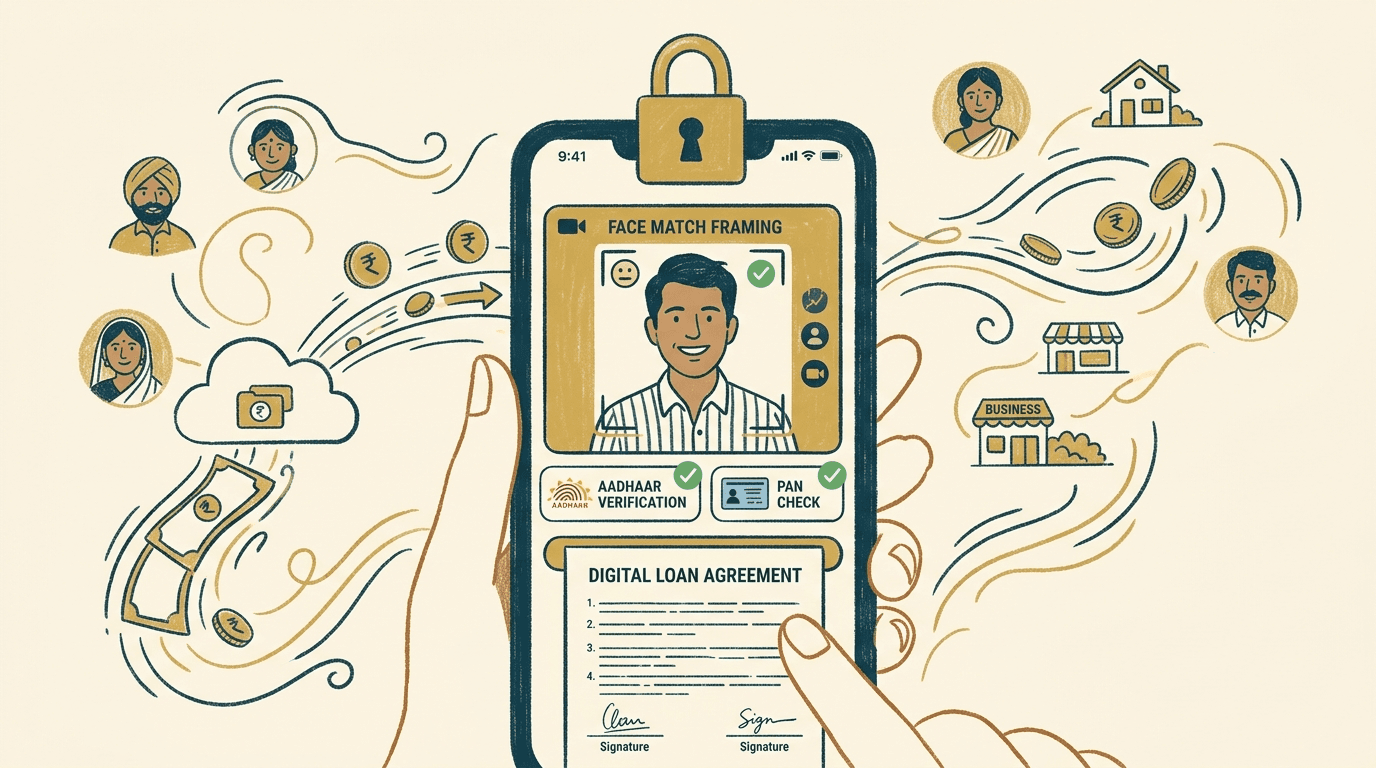
Under the Reserve Bank of India’s rules, every digital loan borrower must be verified under official Know Your Customer directions. Digital lenders cannot skip customer due diligence. They cannot let loan apps act as independent checkers. Non-face-to-face onboarding with Aadhaar OTP allows fast credit checks, but it caps yearly term loans at ₹60,000. To lend more, the lender must complete full verification through Video-based Customer Identification Process (V-CIP) or an in-person visit.
- Digital lending framework: The Reserve Bank of India (Digital Lending) Directions, 2025 took effect on May 8, 2025, consolidating and replacing the 2022 guidelines.
- KYC directions: The Reserve Bank of India repealed the 2016 KYC Master Direction on November 28, 2025, issuing entity-specific directions for commercial banks and Non-Banking Financial Companies (NBFCs).
- Legal disclaimer: This article provides regulatory analysis for operational planning and does not constitute legal, regulatory, tax, or compliance advice.
Who Holds Regulatory Responsibility for Identity Checks in Digital Lending?
The regulated balance-sheet lender maintains sole, non-delegable legal accountability.
The regulated bank or NBFC issuing the loan holds sole legal accountability for verifying the borrower.
In digital lending setups, banks and NBFCs often partner with technology firms called Lending Service Providers (LSPs). These partners run consumer-facing Digital Lending Apps (DLAs). These apps collect borrower details, run credit checks, and display loan offers.
Under central bank rules, hiring an LSP does not transfer legal duty. The balance-sheet lender remains solely responsible for Customer Due Diligence (CDD) and KYC compliance. An LSP acts only as an outsourced vendor. If a partner app fails to verify an applicant properly, the regulatory penalty hits the lender, not the app maker.
To protect borrowers, the central bank set up a public directory on its Centralised Information Management System. Lenders must log all active lending apps on this portal. Borrowers can use it to verify whether an app links to a licensed bank or NBFC.
What Phone Permissions Can Lending Apps Request for KYC?
Explicit one-time access for camera, microphone, and location; zero biometric storage.
Digital lending apps may access camera, microphone, and location hardware only for a one-time onboarding check, and only with explicit borrower consent.
In the past, predatory loan apps accessed phone contact lists, photos, call logs, and continuous GPS location. The 2025 digital lending rules ban this practice entirely.
Loan apps cannot demand broad phone access. Apps may only request access to the camera, microphone, and location during the live verification check. Once the borrower takes the live selfie or finishes the video call, the app must stop accessing those sensors.
Loan apps and tech partners are also strictly barred from saving applicant biometric data. Fingerprint scans and iris data must never touch an LSP server. In addition, all borrower records must stay on physical servers located within India.
How Aadhaar OTP Verification Works, and What Are Its Limits?
Fast non-face-to-face onboarding capped at ₹60,000 aggregate term loans.
Aadhaar OTP verification enables fast online onboarding, but statutory rules cap borrowal accounts at small term loans.
Under Section 17 of the Reserve Bank of India KYC Directions for commercial banks, lenders can onboard individuals remotely using Aadhaar OTP. This non-face-to-face method verifies identity via a one-time code sent to the mobile number registered with UIDAI.
Because this channel has no live human check, the central bank sets strict limits:
- Term loan cap: Total term loans sanctioned through OTP e-KYC cannot exceed ₹60,000 per year.
- Deposit limits: Total deposits cannot exceed ₹1,00,000 across all accounts, and yearly credits cannot exceed ₹2,00,000.
- Single account rule: A borrower can open only one OTP-based account with an institution.
- One-year time limit: The borrower must complete full customer due diligence within one year.
If one year passes without full checks, the account freezes. The lender cannot allow further debits or new loan disbursals until the borrower completes an in-person check or a video verification session.
When Does Digital Lending Require Video KYC (V-CIP)?
Full CDD equivalent removing the ₹60,000 ceiling for higher credit disbursals.
Lenders must run a Video-based Customer Identification Process (V-CIP) whenever loans exceed the ₹60,000 yearly cap, or when an OTP account reaches the one-year mark.
Section 18 of the KYC directions treats V-CIP as a full digital equivalent to branch visits. Completing V-CIP removes the ₹60,000 cap. It lets lenders grant higher credit lines and personal loans.
Under central bank rules, V-CIP requires a live video call run by an authorized bank or NBFC staff member. The video system must meet five core requirements:
1. Live staff interaction
A trained staff member must lead the call. Automated video bots are not permitted for this step.
2. Geo-tagging
The software must capture live GPS coordinates to prove the borrower is inside India during the call.
3. Liveness checks
Anti-spoofing software must confirm the user is a real person rather than a mask, photo, or pre-recorded video.
4. Document validation
The officer must check original identity cards, verifying Aadhaar via offline XML or e-KYC, and checking PAN against official tax databases.
5. Face match
Automated tools must match the live video face with the photo on the official identity record.
The video call recording must be encrypted, tamper-proof, and date-stamped. Lenders cannot store raw video files on unapproved third-party servers.
| Verification Channel | Interaction Type | Annual Loan Limit | Account Validity | Regulatory Role |
|---|---|---|---|---|
| Aadhaar OTP e-KYC | Automated online flow | ₹60,000 aggregate term loans | 12 months without upgrade | Limited entry-level route |
| Video KYC (V-CIP) | Live interactive video call | No statutory loan cap | Ongoing full relationship | Full digital customer due diligence |
| Offline Aadhaar Verification | QR or XML data check | Depends on accompanying steps | Requires in-person or V-CIP upgrade | Official identity proof |
Why Is PAN Verification Mandatory During Digital Loan Underwriting?
Tax compliance under Section 139A and defense against synthetic identity scams.
Permanent Account Number (PAN) validation is required by tax law for all credit accounts to verify borrower identity and stop synthetic fraud.
Under Section 139A of the Income-tax Act, 1961, every person opening an account or taking credit must quote a PAN. In addition, Rule 114B of the Income-tax Rules, 1962 lists loan applications as transactions where quoting a PAN is compulsory.
In digital lending, manual checks take too long. Lenders connect through automated APIs to official databases. These systems match the applicant’s name, birth date, and status in seconds. This step confirms the tax profile is real and stops fraudsters from using fake identities.
“Regulated entities must ensure that outsourcing arrangements with lending service providers do not diminish their core regulatory obligations to verify customer identity.”
How Do Multi-Lender Platforms and Co-Lending Affect Identity Checks?
Neutral display requirements and joint customer due diligence compliance.
When multiple lenders share an app platform or co-lend funds, each institution must maintain clear compliance boundaries.
Digital loan aggregators often list offers from several banks or NBFCs. A legal analysis from Cyril Amarchand Mangaldas notes that the 2025 digital lending directions require multi-lender apps to show an unbiased list of all approved loan options. This prevents apps from secretly favoring one partner.
In co-lending setups under the Reserve Bank of India Co-Lending Directions, a bank and an NBFC fund a loan together. Both lenders remain legally responsible for proper due diligence. One lender may run the customer collection steps, but both balance-sheet partners must ensure the verification followed central bank rules.
How Long Must Lenders Retain Digital Verification Records?
PMLA Rule 9 mandates preserving KYC records for 5 years after loan closure.
Identity files, V-CIP call tapes, and consent records cannot be erased when a loan is paid off.
Under Rule 9 of the Prevention of Money-Laundering Rules, lenders must keep customer identification documents and transaction logs for at least five years after the account closes.
The digital lending rules give borrowers the right to withdraw consent and ask for data deletion. However, this right does not override statutory record laws. A borrower can ask a lender to delete promotional data, but the lender must keep core KYC files, PAN logs, and V-CIP video files for five full years.
What This Means for Digital Lenders and LSPs
Three operational imperatives: automated upgrades, charter alignment, and layered defenses.
The balance between borrower convenience and strict regulatory compliance shapes digital lending workflows across India.
Read together, the digital lending rules and KYC directions point to three clear practical lessons:
- Automated upgrade paths: OTP-based Aadhaar signups work well for small, instant loans, but they are a temporary step. Lenders that issue loans under the ₹60,000 cap need automated upgrade paths. When a borrower needs a larger loan or nears the one-year mark, the app should guide them into a live V-CIP call without drop-off.
- Charter alignment: Rule books differ by lender charter. As detailed in the Reserve Bank of India KYC Directions for NBFCs, paragraph numbering and compliance details differ between banks and NBFCs. Tech platforms working with multiple lenders must ensure their verification journeys fit each partner’s specific rule set.
- Coordinated fraud prevention: Checking a PAN, validating Aadhaar data, running liveness scans, and verifying GPS tags must work together in real time. Top digital lenders treat identity checks as a connected chain that prevents synthetic fraud while keeping approvals fast.
To learn more about electronic verification methods, read our guides on eKYC and digital KYC verification, the technical process behind Video KYC and V-CIP, and automated PAN verification standards.
Frequently Asked Questions
Bhanujeet Choudhary
Head of Compliance, KYCKART
Published September 26, 2026
Disclaimer: This article provides regulatory analysis for operational planning and does not constitute legal, regulatory, tax, or compliance advice. Specific regulatory obligations should be reviewed against current circulars governing your institution.
Next Steps for Lenders
Streamline V-CIP & Digital Lending Onboarding
Equip your digital lending journey with compliant Aadhaar OTP verification, automated V-CIP sessions, and instant PAN cross-checks.
Explore Onboarding Solutionsarrow_forward