Fake Loan Apps and AI Deepfake Lending Scams: What BFSI Institutions Need to Know
A fake loan app is an unauthorized mobile application with no genuine link to an RBI-regulated bank or NBFC. How predatory apps operate from permission harvesting to harassment, the multi-year enforcement record across regulators, what the evidence actually shows on AI deepfakes in lending recovery, and why foundational lending hygiene matters more than speculative controls.
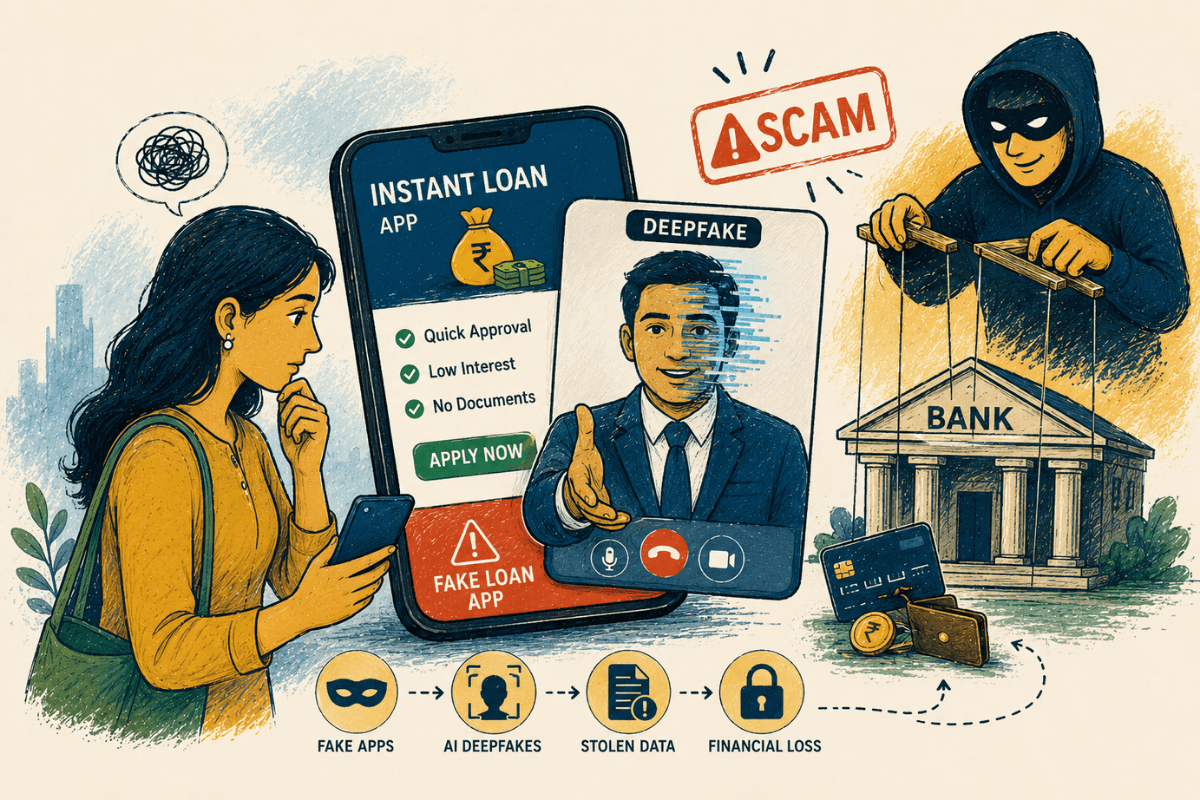
A fake loan app is an unauthorized mobile application with no genuine link to an RBI-regulated bank or NBFC. Rather than disbursing credit in good faith, it harvests personal device data and extracts coercive repayments.
Regulators have addressed this ecosystem through targeted app removals and domain blocks. Meanwhile, risks from AI voice-cloning and deepfakes remain an anticipated threat in lending recovery, not yet documented in official regulatory enforcement.
- The Reserve Bank of India operates a public Digital Lending Apps directory, effective 1 July 2025, confirming reported ties between apps and regulated entities.
- While AI voice-cloning fraud is rising across India generally, official RBI advisories on deepfakes target investment schemes, not loan recovery.
- Regulatory actions against illegal lending apps are separate enforcement events across different years, not a single consolidated crackdown figure.
How Fake Loan Apps Operate: From Installation to Harassment
Deceptive distribution, invasive permission harvesting, and coercive recovery tactics.
Fake loan apps rely on deceptive distribution, aggressive permission harvesting, and coercive recovery tactics to extract money rather than providing genuine credit.
Unauthorized lending platforms distribute software outside official app stores, using direct APK downloads through social media ads and messaging links. This practice sidesteps app-store security vetting. Their underlying goal is built to harvest personal data and extract money through coercion.
During onboarding, these apps demand invasive access to contact lists, storage, and photo galleries. Borrowers are lured by instant approval promises, but find disbursements reduced by undisclosed processing fees.
A borrower requesting ₹10,000 may receive only ₹6,000 to ₹7,000, paired with short repayment windows of 5 to 7 days and escalating late fees.
When borrowers contest unexpected charges or miss short deadlines, recovery agents turn to harassment. Operators call harvested contacts from the borrower’s phone book. In severe cases, debt collectors digitally alter gallery photos into defamatory images circulated to the borrower’s contacts, alongside deceptive calls to employers.
A documented case illustrates this escalation. In Bengaluru, a 36-year-old woman downloaded an app called AMC Credit Park via a third-party link. The same day, ₹2,400 was credited to her Citibank account three times without her consent.
She then received harassing recovery calls threatening to circulate morphed photos of herself and her minor daughter to contacts from foreign numbers. When doctored photos were sent to her contacts, she lodged a police complaint.
The Regulatory Enforcement Record: Distinct Actions Across Years
A timeline of regulatory interventions, store policy removals, and statutory bans.
Enforcement against unauthorized lending apps has occurred in separate phases across multiple agencies, rather than through a single consolidated national crackdown.
Authorities have intervened through distinct actions across different years:
- November 2021 RBI Working Group: RBI’s Working Group examined roughly 1,100 digital lending apps across 81 app stores. It found that around 600 apps operated illegally, including 350 unique illegitimate apps. During the same review, RBI noted that its Sachet portal had received 2,562 digital lending complaints.
- 2022 whitelist submission: In 2022, RBI shared a whitelist of 442 legitimate digital lending apps with the Ministry of Electronics and Information Technology (MeitY) so app stores would host only verified partner entities.
- Google Play Store removals: Following updated policies, Google removed over 2,200 fraudulent lending apps between September 2022 and August 2023, per a February 2024 Rajya Sabha reply.
- February 2023 MeitY ban: In February 2023, MeitY blocked 94 unauthorized lending apps with overseas links under Section 69A of the IT Act.
- Cumulative blocks through December 2025: In a December 2025 Lok Sabha reply, the government reported that MeitY has blocked a cumulative total of 87 illegal digital lending apps under Section 69A, citing borrower harassment, fraud, and personal data misuse.
What Makes a Digital Lending App RBI-Compliant
Mandatory disclosures, flow-of-funds rules, and central directory verification.
A compliant digital lending app must operate through transparent data access, direct bank disbursals, mandatory cost disclosures, and verified regulatory association.
To help borrowers verify lenders, RBI launched a public Digital Lending Apps directory, effective 1 July 2025. Regulated banks and NBFCs submit verified apps through RBI’s Centralised Information Management System.
This directory lets borrowers verify reported ties to regulated lenders, though it does not endorse products. While a separate Digital India Trust Agency was proposed in 2024, no record confirms it was ever constituted.
Under RBI’s September 2022 Digital Lending Guidelines, apps are barred from accessing contact lists, call logs, and stored media files. They may request only one-time camera, microphone, or location access with explicit consent for KYC onboarding.
The 2022 guidelines require all disbursals and repayments to flow directly between the lender’s bank account and the borrower’s bank account, banning pooled pass-through accounts. Lenders must also:
- Appoint a nodal grievance redressal officer.
- Provide a cooling-off period of at least 3 days (or 1 day for tenors under 7 days) to exit penalty-free.
Under RBI’s May 2025 Directions and April 2024 rules, lenders must provide a Key Fact Statement before loan execution. This document discloses the Annual Percentage Rate, total credit cost, recovery mechanisms, and grievance officer details in plain language.
AI Voice Cloning and Deepfakes: What the Evidence Shows
Distinguishing documented investment fraud from anticipated lending recovery tactics.
Regulatory alerts in India have documented deepfake technology in fraudulent investment promotions, while lending-recovery deepfakes remain an anticipated rather than documented pattern.
On 20 November 2024, RBI warned of fabricated deepfake videos of the RBI Governor circulating on social media falsely endorsing investment schemes. The central bank emphasized that its officials never promote commercial investments. This warning addressed investment scams specifically, not loan recovery.
RBI’s long-standing position is affirmed in a February 2012 advisory. It confirms RBI never contacts the public via unsolicited calls or emails to demand funds or credentials.
In a May 2023 McAfee survey across seven countries, 47% of Indian respondents reported that they or someone they knew had experienced an AI voice scam. That figure was nearly double the global average of 25%.
Of those losing money, 48% lost over ₹50,000. Researchers noted three seconds of audio could clone a voice.
Although synthetic voice or video could plausibly be adopted in debt recovery, no published Indian court case or regulatory advisory documents this tactic. Deepfake lending scams remain an anticipated risk rather than an active regulatory category.
Comparing Legitimate Lending Apps and Fake Loan Apps
Side-by-side contrast of operational profiles, permissions, and exit terms.
Compliant digital lending apps and predatory loan apps differ fundamentally across distribution channels, device permissions, fee transparency, and recovery procedures.
| Feature | Legitimate RBI-Linked App | Fake / Unauthorized Loan App |
|---|---|---|
| Distribution channel | Official app stores (Google Play, Apple App Store) and lender websites with verified developer credentials | Direct APK links, social media advertisements, unsolicited messaging channels (WhatsApp, Telegram) |
| Permissions requested | Restricted by RBI rules; one-time camera/mic/location for KYC; no standing media, contacts, or call log access | Demands invasive access to phone contacts, storage galleries, call logs, and SMS messages as a condition of approval |
| Fee transparency & APR | Mandatory Key Fact Statement before contract; clear Annual Percentage Rate; all charges disclosed in writing | Upfront fees deducted from loan disbursement (borrower receives 60-70% of requested sum); undisclosed fees |
| Disbursement & repayment flow | Direct transfer strictly between regulated entity bank account and borrower bank account | Transfers via pooled individual accounts, unauthorized payment gateways, or peer-to-peer UPI handles |
| Cooling-off / look-up exit | Mandatory look-up period (minimum 3 days; 1 day for tenors under 7 days) to exit without penalty | No exit or cooling-off period; repayment demands begin within 5 to 7 days, often accompanied by threats |
| Recovery practices | Strict adherence to Fair Practices Code; contact restricted to designated channels during standard business hours | Coercive calls, contact list harassment, circulation of digitally altered photos to friends, family, and employers |
What This Means for BFSI Institutions
Operational priorities for risk, fraud, and compliance leaders.
For regulated banks and NBFCs, the practical implication of these enforcement records is clear. Transparent borrower disclosures and verifiable directory listings provide far greater immediate security than speculative AI controls.
Read together, the multi-year enforcement record explains why no single headline number captures the scale of illegal lending apps in India. Each source counts something different:
- The 442 apps on RBI’s 2022 whitelist represented legitimate entities submitted to MeitY.
- Google’s removal of over 2,200 apps reflected store policy enforcement.
- MeitY’s cumulative blocking of 87 apps targeted statutory violations involving harassment and data misuse.
This suggests that institutions cannot rely on a single database to assess lending app integrity. An app omitted from one list might simply fall outside that agency’s specific review window.
The evidence also reveals a significant difference between confirmed operational risks and emerging technological threats.
The mechanics of fake loan apps (such as contact-list harvesting, upfront fee deductions, and photo morphing) are thoroughly documented through police reports, parliamentary replies, and regulatory guidelines.
In contrast, the threat of AI voice cloning in loan recovery remains an anticipated risk. While general voice scams affect almost half of surveyed Indians, regulatory advisories from RBI have focused specifically on investment fraud.
The practical implication is that risk and compliance teams should prioritize foundational lending hygiene over deepfake-specific monitoring tools. In practice, this means:
- Verifying that all institution-affiliated lending apps appear accurately on the RBI Digital Lending Apps directory.
- Confirming that lending partners and digital lending apps never request standing contact-list permissions.
- Ensuring every borrower receives a clear Key Fact Statement before disbursement.
Strengthening these documented controls directly addresses the mechanisms unauthorized operators exploit.
Frequently Asked Questions
Bhanujeet Choudhary
Head of Compliance, KYCKART
Published August 30, 2026 · Updated September 28, 2026
Disclaimer: This article describes publicly available regulatory frameworks and reported enforcement actions for informational purposes. It is not legal, regulatory, tax, or compliance advice. Consult qualified counsel before acting on any interpretation here.
Fraud Intelligence for BFSI
Protect Your Lending Channels from App Impersonation and Fraud
Deploy KYCKART’s fraud intelligence suite to detect illicit brand impersonation, verify borrower credentials, and secure digital onboarding against unauthorized intermediaries.
Explore Fraud Intelligencearrow_forward