Graph Analytics for Mule-Account Detection: How Network Defense Powers Modern Fraud Controls
Learn how graph analytics mule account detection uncovers fraud topologies, powers MuleHunter.ai, and aligns with RBI’s proposed debit hold directions.
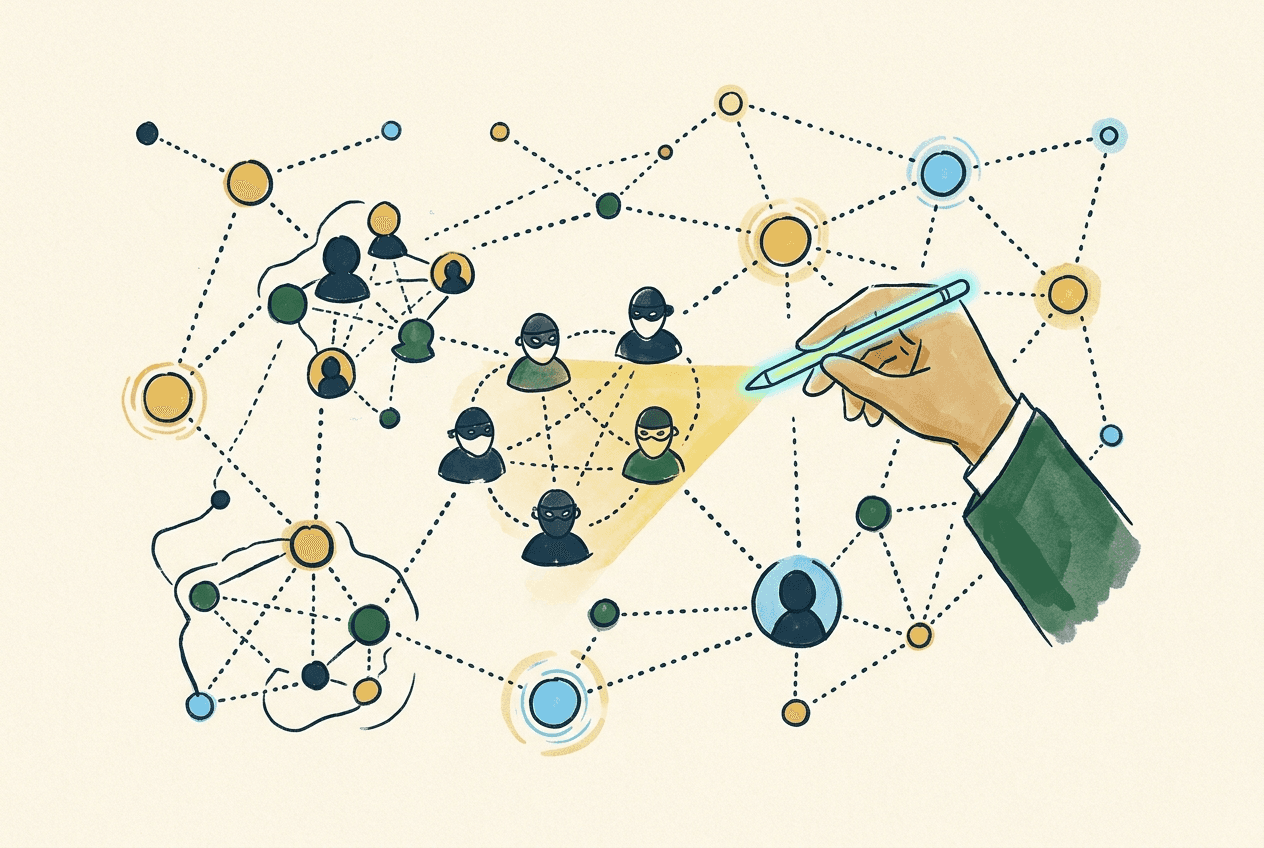
Graph analytics detects money mule networks by mapping bank accounts, customer profiles, and devices into an active network. This structural view uncovers rapid fund routing, collusive rings, and structuring that evade tabular rules. Computing connections in real time powers modern anti-fraud architectures and national tools like MuleHunter.ai.
Where things stand (October 2026)
- •On 11 September 2026, the RBI issued draft KYC Amendment Directions, 2026 for consultation, under a Supreme Court order of 4 August 2026.
- •Public comments close on 2 October 2026, with a proposed start date of 1 April 2027.
- •The draft debit hold procedure is proposed policy, not binding law.
Why Tabular Monitoring Engines Fail Against Mule Networks
Traditional monitoring engines fail against mule rings by checking payments row by row against fixed limits.
Criminals bypass these checks through structuring, or smurfing, splitting stolen funds into small transfers below alert thresholds.
Fast rails like UPI and IMPS accelerate evasion. Fraudsters move funds across account chains in minutes using pass-through transfers. Overnight batch runs finish too late, letting illicit funds exit.
Institutional silos worsen visibility. Per Bureau.id[3], individual lenders see isolated credits and debits while missing multi-hop paths. As DataWalk[4] notes, legacy rules cause 90% to 95% false positives, driving alert fatigue and delayed action.
How Graph Analytics Uncovers Hidden Fraud Topologies
Graph analytics uncovers mule networks by modeling banking data as connected nodes and edges.
Nodes represent accounts, profiles, phone numbers, device IDs, and tokens. Weighted edges represent transfers and shared credentials.
Key graph algorithms detect distinct laundering patterns:
- •Betweenness Centrality: Measures how often accounts sit on paths between entities. Per Neo4j, mules act as bridges connecting victims to cash-out points.
- •Degree Centrality: Tracks flow imbalances: gathering victim funds (fan-in) or dispersing funds across secondary accounts (fan-out).
- •PageRank Risk Propagation: Spreads risk scores from known fraud hubs along payment edges to connected accounts.
- •Community Detection: Louvain and Leiden algorithms detect clusters sharing devices, IP subnets, or phone numbers, per DataWalk.
- •Cycle and Multi-Hop Traversal: Traces circular layering (A to B to C to A) across arbitrary hops in milliseconds, per TigerGraph.
- •Graph Neural Networks: Combines account attributes with graph topology to classify mules before cash-out.
| Dimension | Tabular Rules | Graph Analytics |
|---|---|---|
| Focus | Fixed limits | Centrality and multi-hop paths |
| Evasion | Weak to structuring | Spots fan-in, fan-out, and bridges |
| Alerts | 90% to 95% false positives | Contextual cluster scoring |
| Speed | Overnight batch runs | Sub-second real-time scoring |
“Mule syndicates evade tabular rules by splitting transfers, but graph algorithms expose shared devices, bridge nodes, and flow imbalances connecting them.”
Where MuleHunter.ai Fits into India's National Fraud Architecture
MuleHunter.ai deploys machine learning models to detect mule accounts inside commercial banks.
Developed by the Reserve Bank Innovation Hub (RBIH), an RBI subsidiary, MuleHunter.ai flags accounts receiving, layering, and transferring fraud proceeds. RBIH trained it on 19 behavioral patterns built with commercial banks; pattern weights remain confidential.
Per Financial Express[6], MuleHunter.ai flags roughly 20,000 mules monthly at 85% to 90% accuracy. Without exporting Personally Identifiable Information (PII), lenders send anonymized metrics to RBIH in three stages: Stage I (overnight batch), Stage II (hourly batch), and Stage III (near real-time scoring).
In May 2026, RBIH partnered with the MHA’s Indian Cyber Crime Coordination Centre (I4C), recorded by the Press Information Bureau[7]. This links MuleHunter.ai to I4C’s National Suspect Registry (launched September 2024), which shared over 3.2 million Layer-1 mule accounts as of June 2026 from portal and helpline 1930 data. Enforcement runs through I4C and CFCFRMS, not a separate gazetted scheme.
This aligns with PwC India’s four-part AI fraud taxonomy in The Indian Payments Handbook 2026-2031: anomaly detection, behavioural scoring, network graph detection, and pre-exit intervention. PwC India records 5,997 digital fraud cases involving ₹35.86 crore for FY25-26. See our guides on mule account fraud detection and I4C AI mule detection systems.
How the Draft KYC Amendment Directions Shape Temporary Debit Holds
The RBI’s draft KYC Amendment Directions, 2026 propose uniform procedures for temporary debit holds on suspected mule accounts.
Released by the Reserve Bank of India[8] on 11 September 2026 following a Supreme Court order, the proposed SOP covers Commercial Banks and Urban Cooperative Banks. It outlines immediate temporary debit holds on suspected mule transactions of ₹1,000 or more:
- •Same-Day Notice: Notify customers same day electronically or next day by post with reasons.
- •Explanation Window: Customers receive 20 calendar days to submit explanations.
- •Review Clock: Banks review responses within 10 calendar days.
- •Duration Cap: Holds lapse after 60 calendar days without a statutory police order.
- •Targeted Scope: Holds target the flagged amount; full freezes remain a last resort.
What This Means for BFSI Fraud Architecture
In our view, combining graph analytics, suspect registries, and proposed debit hold rules creates an active defense model.
Read together, these developments show that static rules engines cannot secure instant payment rails. Layered routing moves in seconds, while tabular rules flag fraud hours later. Operationally, graph analytics bridges this detection latency gap by converting ledger rows into real-time risk scores.
This suggests fraud controls are shifting toward automated pre-exit intervention. Linking I4C feeds with MuleHunter.ai helps lenders intercept Layer-1 and downstream mules before cash-out.
In our view, institutions relying on blunt account freezes will face friction under the proposed SOP. Graph scoring provides the precision needed to hold disputed amounts of ₹1,000 or more while protecting legitimate funds.
Practical Evaluation Checklist for Risk and Compliance Teams
Risk teams can evaluate monitoring architecture against network detection and proposed debit hold rules:
- Graph data readiness: Ingest device IDs, IP subnets, and tokens alongside transaction ledgers.
- Multi-hop tracing: Trace fund paths across three or more hops.
- Registry feeds: Ingest identifiers from I4C's National Suspect Registry.
- Targeted holds: Isolate amounts of ₹1,000 or more without full freezes.
- Notice runbooks: Establish same-day notice workflows and 10-day dispute reviews.
Frequently Asked Questions
Author: Bhanujeet Choudhary, Head of Compliance, KYCKART · Published: 2 October 2026. Disclaimer: This article provides regulatory analysis and informational context for operational planning. It does not constitute legal, regulatory, tax, or compliance advice. Regulated entities should evaluate implementation details with qualified legal counsel based on their specific institutional charter and supervisory classifications.
KYCKART Intelligence
See network-level risk before funds leave the account
KYCKART’s fraud intelligence brings device, account, and identity signals together so suspicious networks surface early.
See fraud intelligencearrow_forward