
RBI’s Fraud Numbers Just Flipped: Fewer Cases, Much Bigger Losses
RBI’s FY26 data shows bank fraud cases down 57% to 10,114 while losses jumped 46% to ₹48,021 crore. Why advances, not digital payments, drove the surge.
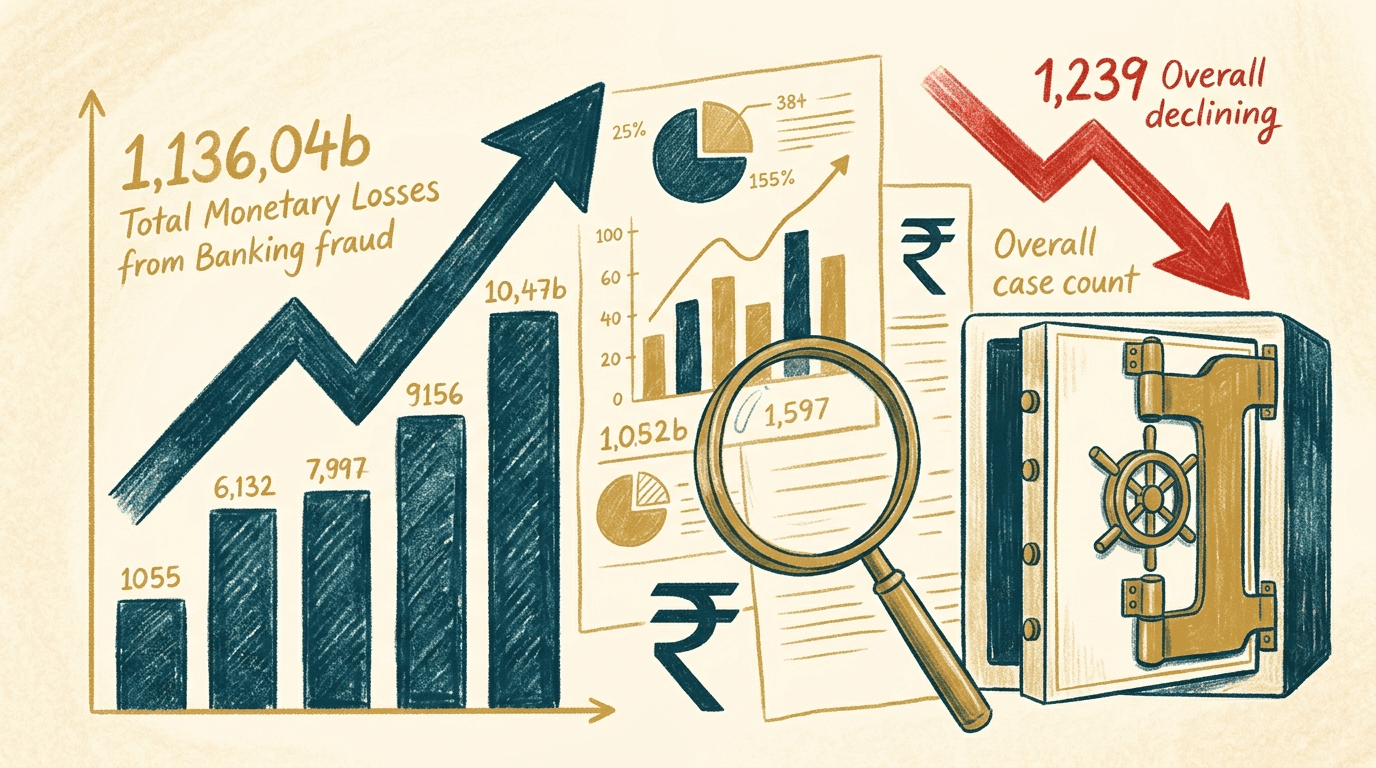
Indian banks reported 10,114 fraud cases in FY2025-26, marking a 57.4% drop from the 23,722 cases logged in FY2024-25. Yet over that same period, the total monetary loss climbed 46.4% to ₹48,021 crore. The banking system is dealing with fewer incident counts, but each failure exposes significantly larger sums of capital.
Understanding this shift requires looking past the aggregate headline. The surge in value was driven by two structural elements: a wave of re-examined legacy corporate loan files and an ongoing concentration of monetary damage in loan advances.
The Three-Year Trend: The Volume and Value Divergence
Scheduled commercial banks experienced an unmistakable decoupling between incident counts and balance-sheet impact.
The Reserve Bank of India Annual Report 2025-26 shows an unmistakable divergence between incident volume and balance-sheet impact across scheduled commercial banks.
| Metric | FY2023-24 | FY2024-25 | FY2025-26 |
|---|---|---|---|
| Total Reported Fraud Cases | 35,800 | 23,722 | 10,114 |
| Total Value Involved | ₹13,930 crore | ₹32,803 crore | ₹48,021 crore |
| Advances Fraud Value | Sourced in aggregate | Sourced in aggregate | ₹40,774 crore |
| Digital Payments Cases | 28,836 | 13,332 | 293 |
| Digital Payments Value | ₹1,452 crore | ₹517 crore | ₹29 crore |
Case volumes peaked in FY24 before declining steadily. Conversely, total value rose from ₹13,930 crore to ₹32,803 crore in FY25, and expanded again to reach ₹48,021 crore in FY26.
The Legacy Classification Wave: 314 Cases Totaling ₹30,199 Crore
Audi alteram partem compliance following the Supreme Court judgment in SBI v. Rajesh Agarwal.
A major factor behind the FY26 total is a formal re-reporting wave.
The official data reveals that 314 legacy cases amounting to ₹30,199 crorepertained to previous financial years and were recorded afresh in FY2025-26. These 314 cases alone represent approximately 62.9% of the year’s total reported fraud value.
This backlog cleared following the Supreme Court judgment dated March 27, 2023 (State Bank of India & Ors. v. Rajesh Agarwal & Ors.). The Court established that banks must comply with the principles of natural justice (audi alteram partem) by providing borrowers an opportunity to be heard before classifying their borrowing accounts as fraudulent. As lenders completed these mandatory hearings and re-examined contested historical accounts, dozens of large-ticket corporate exposures were classified and reported during FY26.
“314 legacy cases totaling ₹30,199 crore represented nearly 63% of FY26 fraud value, clearing a backlog delayed by mandatory natural justice hearings.”
Category Breakdown: Advances Dominate While Digital Payments Plunge
Loan accounts make up 84.9% of financial damage, while digital payments fell to just ₹29 crore.
Examining the operational categories demonstrates where financial exposure actually settles:
- Advances (Lending Operations): Frauds in credit and loan accounts accounted for ₹40,774 crore across 8,640 cases. This single category generated 84.9% of all banking fraud value reported during the year.
- Card and Digital Payments: In sharp contrast, reported card, internet, and digital payment frauds collapsed to 293 cases totaling ₹29 crore. For perspective, this category recorded 13,332 cases and ₹517 crore in FY25, after standing at 28,836 cases and ₹1,452 crore in FY24.
Public Sector Banks (PSBs) reported ₹35,709 crore in fraud exposure, representing 74.4% of total banking losses and a 51.2% rise year-on-year. Private sector lenders reported ₹11,399 crore (23.7% of the total), with foreign banks and smaller specialized institutions making up the rest.
Sorting Through India's Three Non-Comparable Fraud Figures
Distinguishing commercial balance-sheet losses from retail cyber-fraud estimates.
Compliance and risk teams evaluating external reports should note that public discussions cite three separate fraud statistics that reflect distinct scopes and measurement periods:
1. RBI Annual Report 2025-26 Banking Total
Covers all scheduled commercial bank frauds reported in FY26, establishing 10,114 cases and ₹48,021 crore.
2. Visa & RBI Payment System Cyber-Fraud Indicator
Measures consumer cyber-enabled payment fraud specifically, recording ₹22,495 crore across 2.81 million incidents during calendar year 2025.
3. PwC Indian Payments Handbook Figure
Focuses strictly on digital payment channel frauds, tracking 5,997 incidents and ₹35.86 crore for FY25-26.
Conflating these distinct data sets produces misleading assessments. The ₹48,021 crore figure represents institutional credit and balance-sheet risk across commercial lenders, whereas the cyber-fraud metrics reflect retail transaction disputes across wider payment networks.
The Detection Lag: Why Credit Risk Stays Hidden for Years
Supervisory data reveals an average 63-month lag between occurrence and detection in large loans.
Historically, loan-related frauds take years to surface. Supervisory findings published by the Reserve Bank have shown that the average time lag between the date of occurrence and detection was 24 months across all bank frauds, reaching 63 months for large-value exposures of ₹100 crore and above.
Commercial bank loan frauds frequently involve fabricated customer identity documentation, shell-company structures, circular fund routing, and inflated collateral valuations. When these schemes occur during initial underwriting, standard periodic audits and sample checks fail to catch them until the borrower defaults years later.
To address this systemic delay, the regulator’s Fraud Risk Management Directions mandate that regulated lenders install Early Warning Signal (EWS) mechanisms. When potential warning signals emerge, the Red Flagged Account (RFA) framework requires financial institutions to initiate forensic reviews and reach conclusive fraud classifications within specified timeframes to prevent exposure from compounding across multiple quarters.
What This Means for Banking Risk and Fraud Detection Priorities
Moving the primary defense perimeter from post-disbursal monitoring to underwriting gateways.
Reading these metrics together highlights a fundamental operational reality:
The headline drop in case counts can give financial institutions a false sense of security. Public discourse often focuses on retail payment scams, yet the economic damage to banks sits overwhelmingly in loan origination. Digital payments fraud fell to ₹29 crore across the entire banking system in FY26, while advances fraud reached ₹40,774 crore.
“Digital payments fraud fell to ₹29 crore across the entire banking system in FY26, while advances fraud reached ₹40,774 crore. The real loss perimeter sits at loan origination.”
This comparison suggests that institutions misallocate resources when fraud prevention investments focus exclusively on post-disbursal transaction monitoring. Because the average detection lag for large corporate exposures historically stretched to 63 months, loan frauds booked today often remain invisible until multiple financial years pass.
The practical implication for risk committees is that the primary defense line belongs at the underwriting gateway. Verifying corporate identities, confirming beneficial ownership, tracing related-party shell entities, and authenticating source documents prior to sanctioning credit provides far higher loss protection than monitoring outbound payments after loan proceeds are already disbursed.
Frequently Asked Questions
Bhanujeet Choudhary
Head of Compliance, KYCKART
Published September 22, 2026
Disclaimer: This article provides factual regulatory analysis and industry information based on published Reserve Bank of India reports and legal decisions. It does not constitute formal legal, financial, or compliance advice. Regulated entities should consult their legal counsel and refer directly to official RBI directions for institutional policy guidance.
Next Steps for Lenders
Intercept Credit & Advances Fraud at the Gateway
Protect your loan portfolio before disbursal. Deploy automated entity resolution, corporate registry verification, and shell-company intelligence with KYCKART.
Explore Fraud Intelligencearrow_forward