
Is this a customer-initiated outward debit or a new payment mandate?
Step 1: Transaction Type Check
Check if the request is a customer-initiated outward debit or new mandate.
RBI’s Nov 2026 draft rules propose an emergency Stop Switch, Trusted Person Mechanism, and channel caps by July 2027, plus Jan 2027 bank negligence rules.
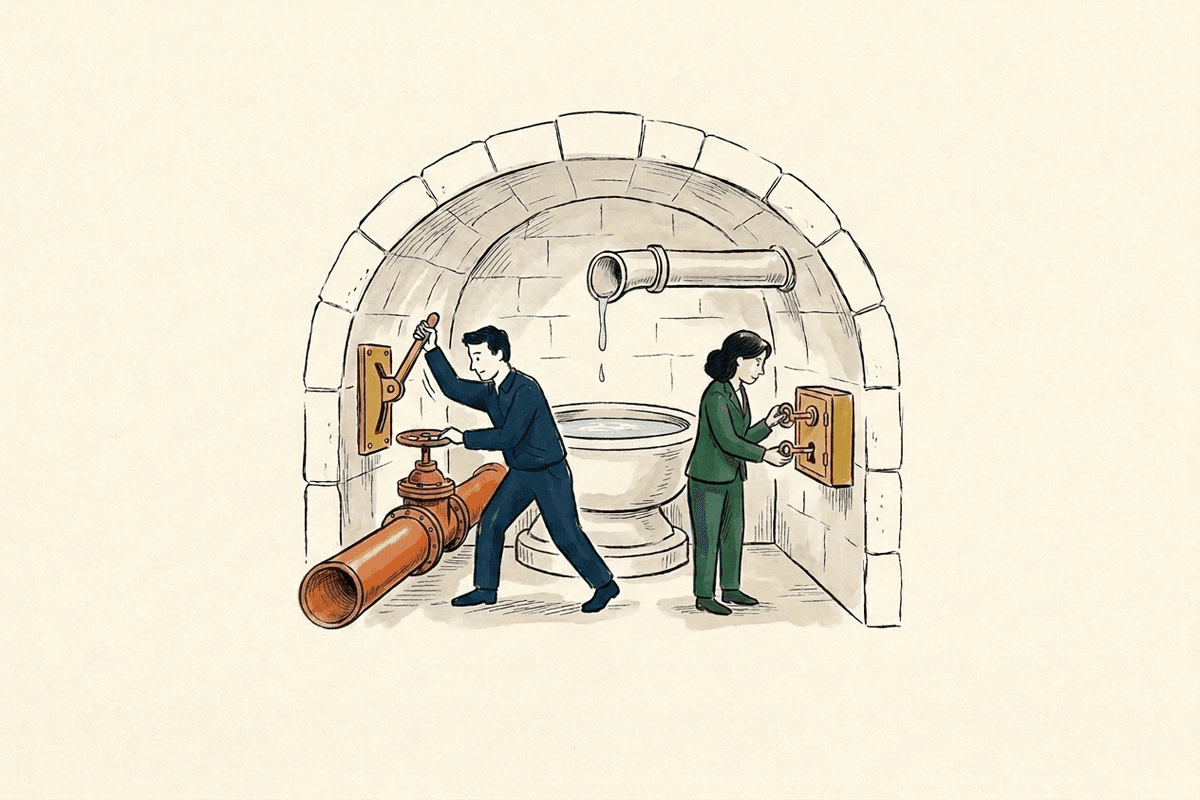
The Reserve Bank of India (RBI) has proposed four fraud safeguards under its draft Fifth Amendment Directions on Responsible Business Conduct, issued on November 23, 2026. The proposals would require banks to build an emergency “Stop Switch” for outgoing debits, a voluntary Trusted Person Mechanism (TPM) for high-value transfers, and granular channel controls by July 1, 2027. An expanded definition of bank negligence is proposed to start earlier, on January 1, 2027.
Where things stand (November 2026)
Transaction routing
A bank’s payment engine would need to check transaction type, Stop Switch status, and TPM triggers in order before applying channel limits.
Pick a scenario to watch an outgoing debit move through Stop Switch and TPM checks.StopHoldProceed
Outgoing debit or payment instruction initiated
Is this a customer-initiated outward debit or a new payment mandate?
Check if the request is a customer-initiated outward debit or new mandate.
No (inward credit, existing mandate, lien, or bank charge)
closeProcess normallyExcluded under proposed paragraphs 76FF and 76FH (Commercial Banks version)
Is the account's Stop Switch currently active?
Check if the account-level Stop Switch is currently active.
Yes
pauseBlock immediatelyDeactivation requires strong authentication plus a bank-assessed reasonable cooling period
Re-check step 02, then continue
Does a covered non-UPI, non-merchant transfer exceed the customer's threshold with TPM enabled?
Check if a non-UPI, non-merchant, non-recurring transfer exceeds the customer's TPM limit on a TPM-enabled account.
Yes (awaiting Trusted Person response)
pauseHold for 1-hour approvalTrusted Person approves via signature or prescribed authentication to release
Re-check step 03, then continue
Yes (Trusted Person rejects or 1-hour window times out)
closeAuto-cancel transactionProposed paragraphs 76FZ and 76FZA (Commercial Banks version)
Under the draft Fifth Amendment Directions (Commercial Banks version), the Stop Switch is an emergency off-switch that blocks all customer-initiated outgoing debits without freezing incoming funds.
Commercial banks would have to provide this Stop Switch across every customer interface (proposed paragraphs 4(25B), 76FF, and 76FM to 76FP, Commercial Banks version). Customers could use it through branches, Automated Teller Machines (ATMs), internet banking, mobile banking, and Interactive Voice Response (IVR). When a customer turns on the switch, the bank would have to send instant SMS and email alerts. It would also need to keep tamper-proof audit logs and run ongoing customer outreach.
The switch stops new outgoing risk while letting routine account activity continue. Banks would separate transactions as follows (proposed paragraphs 76FF to 76FH, Commercial Banks version):
| Transaction or action type | Status when Stop Switch is active |
|---|---|
| Customer-initiated outward debits | Blocked immediately |
| New payment mandates or standing instructions | Blocked immediately |
| Unified Payments Interface (UPI) setup on new third-party apps | Blocked immediately |
| Inward credits to the account | Continues unaffected |
| Ongoing recurring mandates and existing standing instructions | Continues unaffected |
| Liens and bank-initiated debits (charges or loan instalments) | Continues unaffected |
Lifting the Stop Switch would require strong checks (proposed paragraphs 76FI and 76FJ, Commercial Banks version). Customers could turn off the switch only after completing authentication at least as strict as the September 2025 Authentication Directions. Banks would also have to apply a “reasonable cooling period” or other risk controls based on their own risk assessment. Unlike the TPM rules, the draft does not set a fixed hour or day count for this cooling period.
The Trusted Person Mechanism (TPM) is a voluntary second-pair-of-eyes approval step for electronic fund transfers above a customer-chosen amount.
Banks would have to offer TPM for sole individual accounts and joint accounts operated under survivorship clauses (joint accounts with a survivor-operation clause). A customer could nominate an adult aged 18 or older as an extra approval factor. Under the Commercial Banks draft (proposed paragraphs 4(26AA) and 76FQ to 76FS), TPM would exclude UPI payments, merchant payments, and recurring standing instructions or e-mandates.
The draft’s operating rules (proposed paragraphs 76FU to 76FZE, Commercial Banks version) cover four areas:
The draft directions would also require fine-grained channel controls and tighter default settings when opening new accounts.
Customers could turn individual channels on or off and set time windows when channels stay blocked (proposed paragraphs 76FA to 76FC, Commercial Banks version). They could also cap spending per transaction, per beneficiary, per channel per day, and across all channels combined. Customer limits would override higher bank or payment-system limits. For instance, a customer could cap a beneficiary at ₹20,000 per day, a single transfer at ₹10,000, or daily channel spend at ₹50,000.
For cards and new accounts, the Commercial Banks draft (proposed paragraphs 76FD, 76FE, 76FK, and 76FL) would add four safeguards:
While the Stop Switch and TPM are proposed for July 2027, the RBI is moving faster on bank liability rules.
The RBI repealed its July 2017 limited-liability circular and folded those rules into the 2025 Responsible Business Conduct Directions (Commercial Banks version). It then issued the June 2026 Third Amendment Directions (Commercial Banks version), effective January 1, 2027, to cover broader fraudulent Electronic Banking Transactions (EBTs). The November 2026 draft Fifth Amendment Directions now propose to replace sub-paragraph 4(20B) (Commercial Banks version) with a 10-clause definition of “negligence by a bank.”
Eight of those ten clauses (clauses (i) to (vi), (ix), and (x)) are proposed for January 1, 2027:
The final two clauses, 4(20B)(vii) and (viii), cover failing to provide or enforce customer-induced controls (including the Stop Switch) or TPM. Those two clauses are proposed for July 1, 2027. For related context on how bank response timelines interact with fraud disputes, see our guides on customer liability for delayed fraud response and digital arrest scam bank liability.
Read together, the staggered dates in the draft directions point to two separate workstreams for Indian banks.
Finally, compliance teams should prepare comments before the December 14, 2026 deadline. Teams at NBFCs and non-bank PPI issuers should also watch for parallel RBI drafts, since the November 2026 drafts retrieved so far cover only banks.
Bhanujeet Choudhary
Head of Compliance, KYCKART
Published November 24, 2026
Disclaimer: This article is for informational purposes only and does not constitute legal, regulatory, tax, or compliance advice. The interpretations, practical implications, synthesis, and workflow classifications above are based on draft RBI directions open for consultation until December 14, 2026. Institutions should consult qualified legal or compliance counsel before acting on any regulatory requirement or modifying customer-liability policies.
KYCKART Intelligence
Explore how KYCKART supports real-time account state flags, tamper-proof audit trails, and automated fraud-control workflows.
Explore Fraud Intelligencearrow_forward