CKYCRR Full Form: What It Means and Why It Matters in KYC
CKYCRR stands for Central KYC Records Registry, the CERSAI-run system that lets banks, NBFCs, and insurers reuse a customer’s verified KYC record instead of collecting it again.
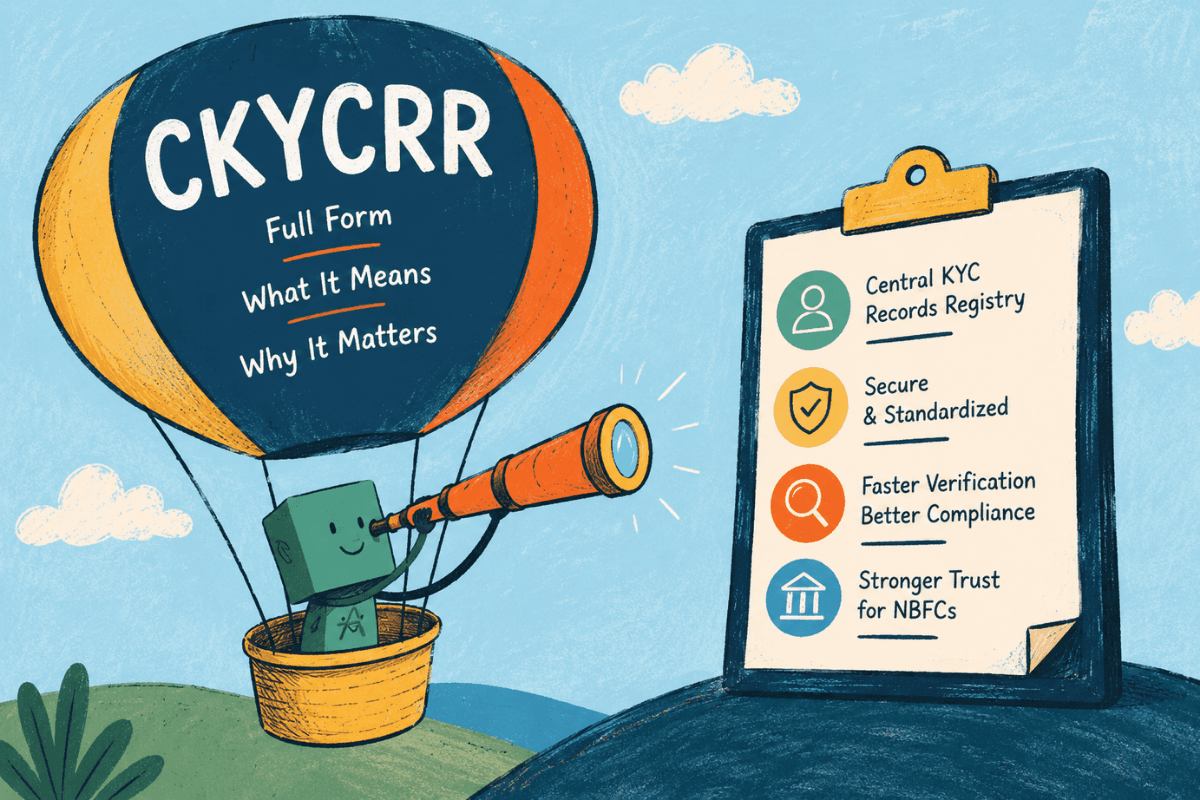
CKYCRR stands for Central KYC Records Registry, the centralized system that stores a customer’s verified KYC record so it can be reused across banks, NBFCs, insurers, and other regulated entities instead of being collected from scratch every time[1]. CERSAI, the Central Registry of Securitisation Asset Reconstruction and Security Interest of India, is the body authorised to operate it[2]. For a compliance team, CKYCRR is already the backbone of how repeat KYC gets avoided across India’s financial system.
What CKYCRR Actually Is
CERSAI runs CKYCRR, but CERSAI wasn’t built for this purpose originally. It started under Section 20(1) of the SARFAESI Act, 2002, which let the central government set up a registry, with its own seal, to record transactions involving securitisation, asset reconstruction, and security interests[3]. That registry went live on 31 March 2011[4].
The KYC mandate came later. On 26 November 2015, the Ministry of Finance’s Department of Financial Services issued notification S.O. 3183(E), authorising CERSAI to also act as the Central KYC Records Registry, under the Prevention of Money-Laundering Act, 2002[5]. CERSAI now carries two separate jobs under two separate statutory origins: the SARFAESI-based security-interest registry, and the PMLA-based KYC registry[3][5].
CKYC and CKYCRR get used interchangeably online, but they’re not the same thing. CKYC refers to a customer’s verified KYC record and the identifier attached to it. CKYCRR is the registry infrastructure that stores, manages, and serves that record. HyperVerge and Signzy both describe it informally this way: CKYC is the file, CKYCRR is the filing cabinet[11].
Why the Registry Exists
Before CKYCRR, KYC didn’t travel. A customer who had already completed full verification at one bank still had to resubmit PAN, Aadhaar, and address proof at the next bank, the next NBFC, the next insurer, every single time. CKYCRR’s mandate, under the Prevention of Money-Laundering (Maintenance of Records) Rules, 2005, was to fix that problem. The Rules required a single central registry to receive, store, safeguard, and retrieve KYC records electronically, so any reporting entity could pull an existing verified record instead of re-collecting it[6][7].
The registry didn’t launch instantly on paper; it went live gradually. Business Standard’s coverage at the time covered CKYCRR’s phased “live run,” which began 15 July 2016 for new individual accounts: banks could start uploading KYC data to CERSAI for individual accounts opened on or after that date[8].
How the KIN Works
Once a customer’s KYC record is successfully registered with CERSAI, they’re issued a KYC Identification Number, or KIN, a unique 14-digit number sometimes called the CKYC number or CKYC ID[9]. Cleartax’s guide to the process puts generation time at roughly 2 to 7 working days from successful document submission. CERSAI then sends an SMS or email notification to the customer’s registered mobile number or email address once the KIN is ready[10].
From that point, the KIN does the work. A customer opening an account at a new bank or applying for a loan can hand over their KIN instead of their documents[12]. The new institution retrieves the existing verified record from CKYCRR directly, without asking the customer to resubmit PAN, Aadhaar, or address proof again, unless something in the customer’s information has changed or another specified condition applies[7].
Who Has to Comply
CKYCRR compliance isn’t optional for regulated entities. It applies across institutions regulated by the RBI (banks, NBFCs, payment banks, cooperative banks), SEBI (stock brokers, depository participants, mutual funds, portfolio managers), IRDAI (insurance companies and intermediaries), and PFRDA (NPS intermediaries and pension fund managers), under the Prevention of Money-Laundering (Maintenance of Records) Rules, 2005[17].
The scope of that requirement expanded over time. CKYCRR uploads originally applied to individual accounts only. The RBI amended its Master Direction on KYC, effective 18 December 2020, to extend the same upload requirement to legal-entity customers, covering legal-entity accounts opened on or after 1 April 2021, as well as existing accounts during periodic KYC updation, according to law firm Khaitan & Co.’s summary of the amendment[14]. Under the amended direction, entities must upload new legal-entity KYC records to CKYCR within 10 days of the account relationship starting[15]. Corporate law advisory firm Vinod Kothari & Company noted at the time that the registry’s finalized upload format for legal-entity records only became available in late 2020[16].
Periodic re-verification is risk-based, not a flat schedule[20]:
| Risk Category | Full KYC Updation Required |
|---|---|
| High-risk customers | At least once every 2 years[20] |
| Medium-risk customers | At least once every 8 years[20] |
| Low-risk customers | At least once every 10 years[20] |
That timeline eased further in mid-2025. On 12 June 2025, the RBI issued amended KYC directions, per market coverage including Upstox, instructing banks to let transactions continue and complete KYC updation for low-risk customers within one year of it falling due, or by 30 June 2026, whichever is later[21].
Why It Matters for BFSI Onboarding
For a bank, NBFC, or insurer, CKYCRR means checking whether a customer is already verified instead of verifying them again from scratch. Instead of collecting and independently checking PAN, Aadhaar, and address proof for every new account, a compliance team can retrieve an existing KIN-linked record and move straight to whatever incremental checks the product actually needs[12]. Zoop, a KYC compliance vendor, points to loan approvals and credit card applications specifically as processes this speeds up, since verified data gets retrieved rather than re-collected[13].
The registry is also still being upgraded. In the Union Budget 2025, presented 1 February 2025, Finance Minister Nirmala Sitharaman announced a revamped Central KYC Registry with a streamlined system for periodic updating, to roll out during the year[18]. Business Standard’s coverage of the announcement described additional data-protection measures for the documents used in Central KYC, including Aadhaar, PAN, voter ID, and driving licence, and framed the reform as a way to cut redundant documentation, lower operational costs, and speed up onboarding, digital banking integration, loan processing, and insurance underwriting[19].
Vendors including Surepass and HyperVerge have described this reform direction as “CKYCRR 2.0,” moving the registry from delayed batch-file uploads to real-time API-based submission, instant validation, AI-assisted de-duplication, and stronger consent and masking requirements such as Aadhaar masking and OTP-based consent[22]. This is a vendor and industry characterization of where the Budget 2025 reform is headed. CERSAI and the RBI have not published a primary document naming or dating a “CKYCRR 2.0” rollout as of this writing.
What the KIN Timeline Means for Onboarding Speed
A customer’s first encounter with CKYCRR still takes 2 to 7 working days between document submission and a working KIN[10]. Every encounter after that skips the wait, since a new institution can retrieve the already-verified record tied to that KIN instead of re-collecting PAN, Aadhaar, and address proof from scratch[7][12]. Read together, this means the onboarding-speed benefit CKYCRR is generally sold on depends heavily on which institution in a customer’s sequence is doing the checking: the first institution still absorbs the full multi-day KIN-generation wait, and every institution after it gets the faster, document-free retrieval instead[7][10][12].
The practical implication is that a bank, NBFC, or insurer’s own product timelines shouldn’t assume CKYCRR compresses onboarding evenly across its customer base. A customer with no prior KIN goes through the same document collection and multi-day wait any first KYC has always required, before a record even exists to reuse. Loan approvals and credit card applications that get faster because verified data gets retrieved rather than re-collected[13] are describing an applicant who already has a KIN from an earlier institution. For a compliance or product team measuring onboarding speed, that suggests tracking how many applicants already carry a retrievable CKYCRR record separately from raw onboarding time, since the two populations behind a single average move at genuinely different speeds.
This article summarizes publicly available regulatory information for informational purposes. It isn’t legal or compliance advice; verify specific obligations against the primary RBI and CERSAI notifications, and your own counsel, before acting on them.
Bhanujeet Choudhary
Head of Compliance, KYCKART
Published August 11, 2026 · Updated August 14, 2026
KYCKART Intelligence
Stop Re-Collecting KYC Your Customers Already Completed
KYCKART helps banks, NBFCs, and insurers check CKYCRR before re-verifying a customer from scratch, so onboarding moves at the speed a KIN-linked record actually allows. Speak with our team to see how it fits your stack.
Explore Onboarding Solutionsarrow_forward