
GST Check: How to Verify a GSTIN Online
Learn how to verify a GSTIN online using the official GST portal, decode the 15-digit format, check registration status, and avoid shell-company fraud in corporate onboarding.
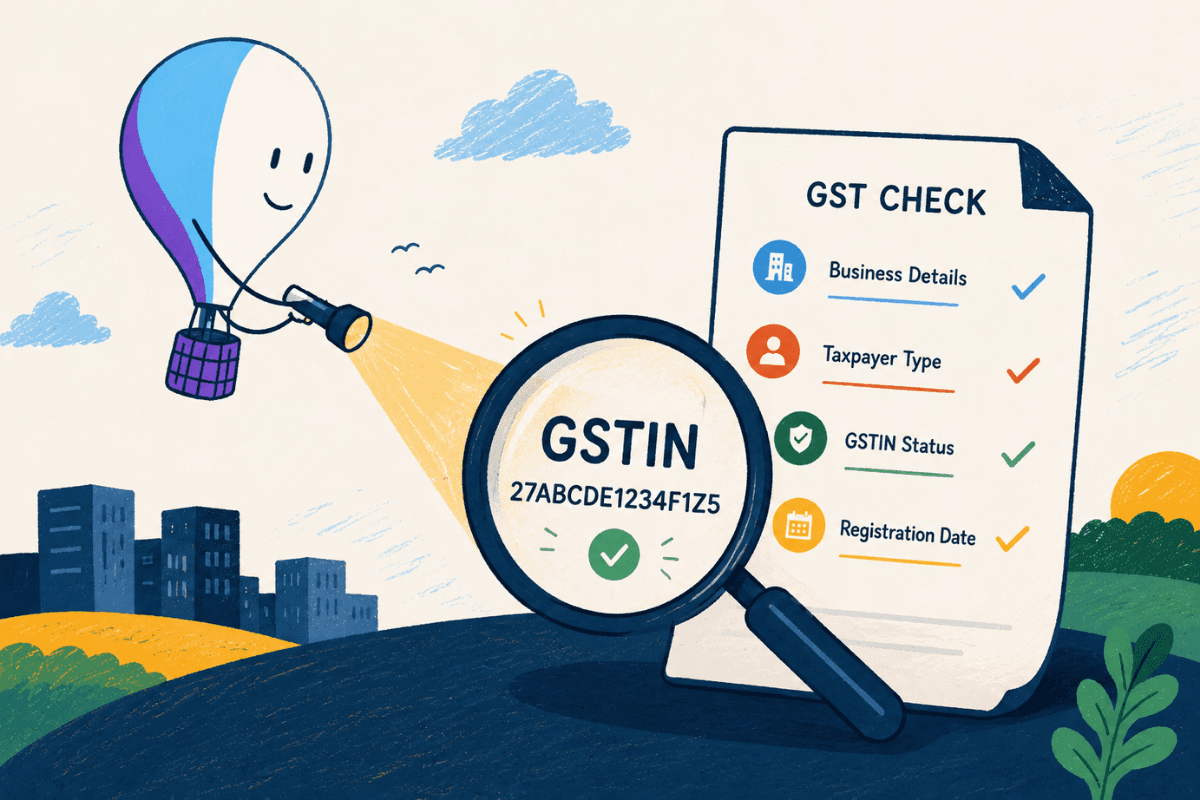
To verify a GSTIN in India, visit the Goods and Services Tax Network’s official Search Taxpayer tool. Enter the 15-digit number and the security captcha to review registration details without logging in. The search displays the legal business name, trade name, registration status, business constitution, and return filing history. While a basic check confirms that a number exists, financial institutions also inspect active status and operational records to identify shell companies.
- The GST portal’s public search tool remains free and accessible without an account for basic identity checks.
- Nationwide biometric Aadhaar authentication for new GST applicants is active following a phased state rollout.
- Under GST 2.0 reforms, automated registration grants approval within three working days for low-risk applicants.
- This guide outlines regulatory verification procedures and does not constitute legal, tax, or compliance advice.
What the 15 Digits in a GSTIN Mean
Decoding the alphanumeric structure from state code to check digit.
Every business registered under India’s Goods and Services Tax receives a 15-character alphanumeric identifier called a GSTIN. Each segment of the number communicates specific legal and administrative details about the entity, as outlined in technical guides by Forbes India.
The first two digits represent the state code where the business is registered. The next ten characters contain the entity’s Permanent Account Number (PAN). Digit 13 represents the entity code, numbering multiple registrations under the same PAN within a single state from 1 through 9, followed by letters A through Z. Digit 14 is the fixed letter “Z” reserved for future administrative use. The final character is a check digit generated by a weighted checksum algorithm to catch entry errors.
| Position | Meaning | Maharashtra Example: 27ABCDE1234F1Z6 |
|---|---|---|
| Digits 1–2 | State code of registered entity | 27 (Maharashtra) |
| Digits 3–12 | PAN of business or proprietor | ABCDE1234F |
| Digit 13 | Registration count for PAN in state | 1 (First registration) |
| Digit 14 | Default character | Z |
| Digit 15 | Check digit for validation | 6 |
The 15th digit catches input errors before a query reaches the database. Technical guides describe this as a Mod-36 checksum calculation. In daily operations, an incorrect digit causes an immediate validation failure.
How to Verify a GSTIN Online: Step by Step
Step-by-step verification on the GST Network portal and e-way bill system.
You can verify any GST registration in three steps using official government portals. The GST Network maintains the primary search utility, while secondary options exist on the e-way bill system.
Step 1: Open the official search tool
Navigate to the Search Taxpayer service on the official GST portal tutorial. You do not need a login or account to perform a basic check.
Step 2: Enter details and captcha
Type the 15-digit GSTIN or Unique Identification Number (UIN) accurately. Complete the visual captcha shown on the screen and click search.
Step 3: Review taxpayer records
The system returns public data immediately. Unregistered guests can review:
- Legal name of the business
- Trade name and constitution of business (proprietorship, partnership, private limited company)
- Effective date of registration
- Principal place of business address
- Filing status of recent monthly and quarterly returns
- Current registration status (Active, Suspended, or Cancelled)
Logging into an account reveals additional records: promoter names, turnover brackets, e-way bill history, cash tax ratios, and Aadhaar authentication status. Users can also search registrations via the e-way bill portal’s “Display Assesses Profile” feature.
What a GST Status Check Reveals: Active, Suspended, or Cancelled
Interpreting operational states and understanding compliance trigger points.
A status inquiry reveals whether a business is legally entitled to issue tax invoices and pass tax credits. The portal returns one of three operational states, described in TaxBuddy’s compliance analysis.
An Active status confirms the registration is valid. The taxpayer can issue legal tax invoices, file monthly returns, collect GST from buyers, and pass Input Tax Credit (ITC).
A Suspended status indicates a temporary administrative pause. During suspension under Section 39 of the Central Goods and Services Tax Act, a business is not required to file returns. However, it cannot issue taxable invoices or pass ITC to customers. Suspension ends when the taxpayer rectifies the underlying discrepancy or tax officers conclude cancellation proceedings.
A Cancelled status marks the termination of registration. The business cannot legally charge GST or issue valid tax documents unless authorities formally revoke the cancellation order.
“Suspended registrations cannot issue legal tax invoices, collect taxes, or pass Input Tax Credit to buyers—signaling immediate transaction risk.”
Registrations usually face suspension or cancellation for predictable compliance failures:
- Failure to file GST returns for six consecutive months (or three consecutive tax periods for composition dealers).
- Significant discrepancies between outward supplies reported in GSTR-1 and tax paid in GSTR-3B.
- Mismatches between generated e-way bills and declared GSTR-3B turnover.
- Physical absence from the declared principal place of business during tax inspections.
- Obtaining registration through fraud, wilful misstatement, or suppression of facts.
When non-filing triggers cancellation proceedings, filing overdue returns and clearing pending dues causes the automated system to drop proceedings and restore active status.
Common Reasons a GSTIN Search Fails
Clerical errors, expired sessions, and high-traffic portal bottlenecks.
When an online query returns an error, the cause is usually clerical or technical. Understanding common failure points saves time during onboarding checks:
- Typographical errors: Entering 14 or 16 characters instead of 15, confusing the letter “O” with the number “0”, or mistyping the PAN segment.
- Cancelled numbers: Searching for an enterprise whose registration was terminated before digital archiving or during recent anti-evasion drives.
- Captcha timeouts: Captcha codes expire quickly, and case-sensitive characters can cause unexpected search failures.
- Portal peak traffic: Heavy portal load near monthly return filing deadlines (such as the 11th or 20th of each month) can cause slow responses or connection drops.
If a number fails, teams should verify character strings against physical registration certificates before escalating.
Why Banks and NBFCs Verify GST Numbers
RBI Master Direction mandates, entity validation, and cash-flow underwriting.
Verifying a business registration is not merely commercial best practice. For regulated Indian lenders, verifying GST credentials forms a mandatory part of customer onboarding.
The Reserve Bank of India mandates GST verification in its Master Direction on Know Your Customer. Regulated entities must verify customer GST details against the issuing authority’s database whenever GST information is available. For sole proprietorships, a GST certificate serves as an officially valid document proving business activity. RBI updated these rules in October 2023 to demand tighter ongoing monitoring across commercial relationships.
In modern banking operations, GST checks integrate into broader Know Your Business onboarding. Compliance officers combine GST records with PAN verification, Ministry of Corporate Affairs director lists, Udyam registration databases, and physical address inspections. This end-to-end framework supports the ongoing compliance requirements discussed in our guide on building a living customer record.
Beyond basic identity validation, digital lenders rely on GST filing trends for underwriting. Flow-based MSME lending programs evaluate sales consistency, inter-state supplier concentration, and cash-flow regularity using GST filing data. Lenders cross-examine self-reported financial statements against official GST returns to flag turnover inflation before approving credit lines.
The Limits of GST Verification and the Shell-Company Risk
Paper-only enterprises, fake ITC syndicates, and biometric safeguards.
A successful GST search confirms that a number exists in government records. However, verification alone does not prove that a company conducts genuine commercial activity.
As risk analysts at TartanHQ observe, paper-only businesses frequently pass registry lookups. Organised syndicates obtain authentic registrations using dummy directors or rented addresses, enabling shell companies to display an Active status while conducting zero genuine manufacturing or trade.
This blind spot featured in public reporting on a ₹9,000 crore corporate loan scam. Investigative reports noted that analyzing GST filing regularity, rather than registration existence alone, could have highlighted shell networks earlier. While fraud analysts highlighted this gap, regulators did not cite GST verification failures as the formal cause of the default. This pattern mirrors shell-company risks detailed in our review of bank fraud warning signs.
Enforcement records demonstrate the growing scale of invoice manipulation. In financial year 2024, tax authorities detected 9,190 fraudulent Input Tax Credit cases valued at ₹36,373.36 crore. By financial year 2026, detection totals reached ₹74,782 crore across 30,162 cases. Officials credit automated invoice cross-matching, network graph analytics, and electronic invoicing expansions for this higher detection rate.
Common fraud models include circular billing and forged export documentation. In one documented case, investigators dismantled a ₹150 crore bogus billing ring operating across multiple states. Under Section 132 of the Central Goods and Services Tax Act, generating fake invoices exceeding ₹5 crore is a non-bailable criminal offence carrying up to five years in prison.
To secure registrations, authorities mandated biometric Aadhaar authentication for new applicants in July 2024, rolling it out across states through 2025. Applicants who bypass biometric checks face physical premises inspections within 15 days. Readers can review verification mechanics in our guide on Aadhaar verification methods. Under GST 2.0 reforms from November 2025, low-risk applicants receive automated registration approvals within three business days.
What This Means for Onboarding and Underwriting Teams
Separating point-in-time registry checks from ongoing economic verification.
Read together, statutory directives and fraud statistics highlight a clear operational division for financial institutions.
Meeting the RBI mandate requires verifying that a borrower’s GSTIN exists on the government portal. However, protecting an institution against credit default requires verifying that the business is economically real. An active status confirms that tax authorities have not yet cancelled the registration. It does not prove that goods move through a warehouse or that reported turnover reflects commercial sales.
“Meeting the RBI mandate requires verifying that a GSTIN exists. Protecting an institution requires verifying that the business is economically real.”
Underwriting workflows should therefore separate registry checks from fraud detection:
- Layer multi-source corporate records: Pair GSTIN matches with Ministry of Corporate Affairs director registries and Udyam filings to verify beneficial ownership.
- Inspect filing consistency over time: Review GSTR-1 and GSTR-3B filing regularity over the preceding 12 months rather than relying on a single point-in-time status check.
- Factor registration age and state authentication: GSTINs created after biometric verification took effect in a given state present stronger identity assurance than older registrations created before biometric rules applied.
- Verify e-way bill transport logs: Cross-reference declared invoice volumes against actual transport generation to identify circular invoice trading.
Institutions that treat GSTIN checks as one layer within an integrated verification stack can fulfill regulatory duties while closing the operational loopholes that shell networks exploit.
Frequently Asked Questions
Bhanujeet Choudhary
Head of Compliance, KYCKART
Published August 17, 2026 · Updated September 29, 2026
Disclaimer: This article synthesises publicly available Reserve Bank of India, GSTN, and CBIC information for educational purposes. It does not constitute legal, tax, or compliance advice. Specific regulatory obligations should be reviewed against current circulars governing your institution.
Next Steps for Lenders
Automate GSTIN Verification & KYB Due Diligence
Integrate automated GSTIN status verification, director matching, and corporate registry lookups into your commercial onboarding pipeline.
Explore Onboarding Solutionsarrow_forward