
Penny Drop Verification: How It Works and Why It’s Used
Penny drop verification confirms a bank account by crediting Re 1 and matching the registered name. How the process works, its regulatory backing under PFRDA and SEBI, and how it differs from RBI’s RTGS/NEFT name look-up facility.
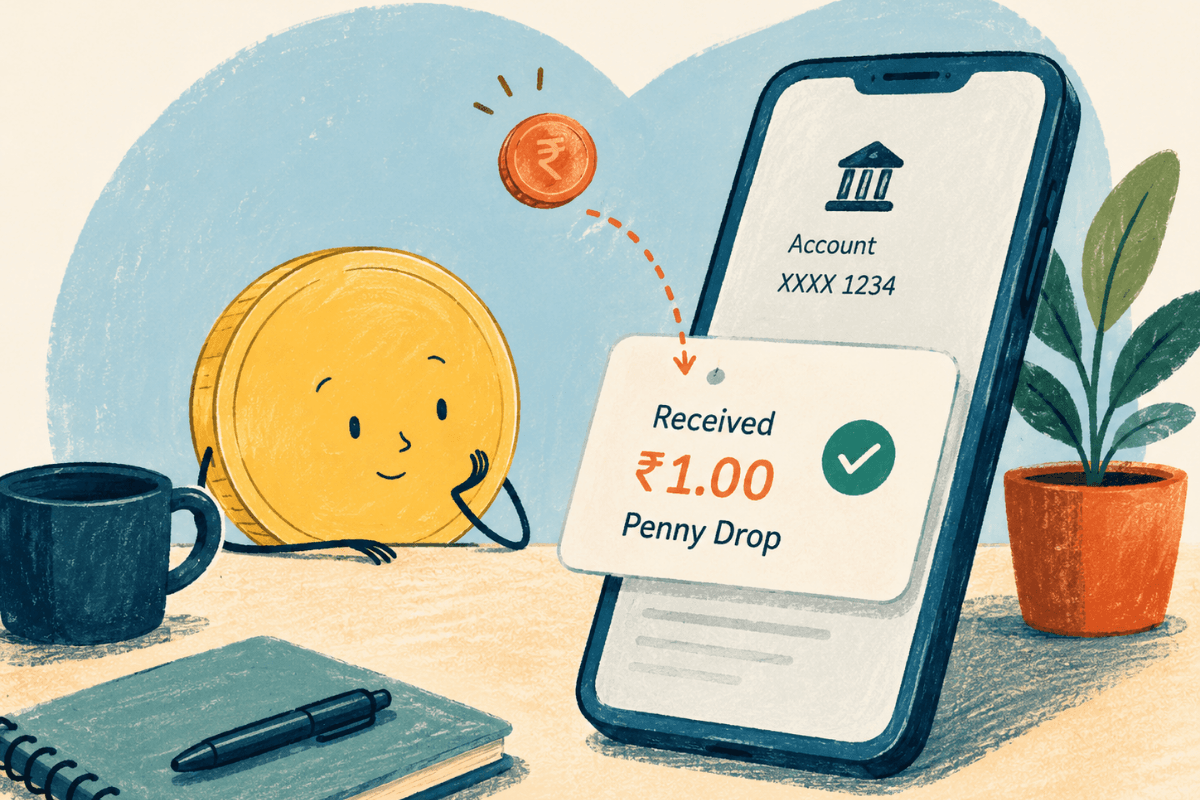
Penny drop verification confirms that a bank account is real and belongs to the person or business that submitted it, by crediting a small amount, typically Re 1 in India, into the account and reading back the registered account holder’s name from the receiving bank. That returned name is then compared against the name the customer or vendor provided, to confirm account ownership and validity[1].
This guide covers how the process works, what it costs, the payment rails behind it, where regulators require it, how it compares with RBI’s RTGS/NEFT name look-up facility, where it’s used, its variants, and what it doesn’t cover.
How Penny Drop Verification Works
The process follows a fixed sequence[2]:
Submit account details
The customer or vendor submits their bank account number, IFSC code, and the name expected on file.
IFSC check
The verification provider checks the IFSC against a bank database.
Micro-deposit sent
A Re 1 micro-deposit goes out to the account via IMPS, NEFT, or UPI.
Bank returns status
The receiving bank returns the account's status (active, dormant, frozen, or closed) along with the registered account holder's name.
Name matched
The returned name is matched, exact, fuzzy, or phonetic, against the name the customer supplied, and the check resolves to one of three outcomes: verified, mismatch, or invalid.
Mismatch vs. invalid: two different failure types
A “mismatch” and an “invalid” result look similar on the surface but point to different problems.
| Outcome | What It Means | Underlying Problem |
|---|---|---|
| Mismatch | The account is active and exists, but the registered name doesn't match the name supplied[3] | Typo, or a fraud-risk signal |
| Invalid | The account number or IFSC is incorrect, or the account is dormant, frozen, or closed[3] | Account-detail error |
What it costs
Per-check cost estimates from IndiConnect and HyperVerge run roughly ₹0.50 to ₹3 per verification[4]. That’s separate from the Re 1 itself, which stays with the account holder rather than functioning as a fee[4].
The Payment Rails Behind It
Penny drop transfers move over one of three rails: IMPS (Immediate Payment Service), NEFT, or UPI. IMPS is owned and operated by the National Payments Corporation of India (NPCI), running on NPCI’s National Financial Switch network. It launched publicly on 22 November 2010 and operates 24x7, enabling instant inter-bank electronic fund transfers[5].
Where It's a Regulatory Requirement, and Where It Isn't
Penny drop verification is a named requirement in specific regulatory frameworks and a voluntary risk-management practice everywhere else it’s used; no single rule mandates it across Indian finance[13].
PFRDA and the National Pension System
PFRDA made penny drop verification mandatory for NPS via Circular No. PFRDA/2021/21/SUP-NPST/2, dated 20 July 2021. The circular required successful penny drop verification, including name matching, before processing any NPS exit or withdrawal request, or any request to change a subscriber’s registered bank account details. Central Recordkeeping Agencies (CRAs) had 30 days from issuance to build the required functionality[6].
A follow-up circular (No. PFRDA/2023/29/Sup-CRA/09, dated 25 October 2023) reinforced that mandate: penny drop verification “has to be necessarily successful with name matching” for exit/withdrawal processing and for bank-account-detail changes, and no such request “shall be allowed in case of failure of penny drop verification by the CRA.” This applies across NPS, Atal Pension Yojana (APY), and NPS Lite. On failure, the CRA must notify the subscriber by mobile or email and alert the relevant nodal office or POP, and re-verification is required before the request can proceed[7].
SEBI and digital KYC
SEBI’s circular dated 24 April 2020, addressed to SEBI-registered intermediaries on the use of technology for KYC (no separate circular reference number is available in the sourcing for this piece), permitted bank account verification via penny drop, or another bank-API-based mechanism, as part of digital KYC, letting SEBI-regulated entities complete account verification without requiring a physical copy of a cancelled cheque, the prior norm[8].
Crypto and virtual digital assets
India’s Financial Intelligence Unit (FIU-IND), under the Union Ministry of Finance and acting under the Prevention of Money Laundering Act, issued AML/KYC guidelines for virtual digital asset (crypto) exchanges, reported 8 January 2026 (no specific guideline or instrument number is available in the sourcing for this piece). The guidelines mandate a live selfie with liveness detection and penny-drop bank account verification, described as “a refundable Rs 1 credit… taken by the banking or payment gateway from a customer to authenticate their bank account,” alongside PAN, geo-coordinates with timestamp, and IP address collection at onboarding[11]. Under the same guidelines, crypto exchanges must re-run KYC updation checks on high-risk clients every six months, and on all other clients annually[12].
Penny Drop vs. RBI's RTGS/NEFT Name Look-Up Facility
RBI introduced a separate, free name-lookup facility for RTGS and NEFT transfers via circular RBI/2024-25/99, dated 30 December 2024, directing all RTGS/NEFT member banks to implement it by 1 April 2025. It is mechanically distinct from penny drop: a name-lookup query against the receiving bank’s Core Banking Solution, not a live money transfer[9][10]. RBI’s own circular notes that UPI and IMPS already provided an equivalent beneficiary-name-verification capability before this RTGS/NEFT extension[9].
| Aspect | Penny Drop Verification | RBI’s RTGS/NEFT Name Look-Up Facility |
|---|---|---|
| What it checks | Deposits Re 1 and reads back the registered name and account status from that live transaction[1][2] | Queries the receiving bank's Core Banking Solution directly for the registered name[10] |
| Money movement | Yes, a real Re 1 credit is made[1] | No, it's a name-lookup query only[10] |
| Payment rails used | IMPS, NEFT, or UPI[2][5] | Applies to RTGS and NEFT transfers specifically[9] |
| Rollout | Established industry practice; mandated for NPS by PFRDA in 2021[13][6] | Circular RBI/2024-25/99, dated 30 December 2024, directed implementation by 1 April 2025[9] |
| Cost to user | Re 1 credited (refundable, not a fee), plus a provider check fee of roughly ₹0.50-₹3[4] | Free, available via internet banking, mobile banking, and bank branches[9] |
| Stated purpose | Confirms account ownership as part of onboarding or payout due diligence[6][8] | Helps remitters “avoid mistakes and prevent frauds” before sending an RTGS/NEFT transfer[9] |
Where Penny Drop Verification Is Used
Reported use cases for penny drop span BFSI and adjacent sectors: pre-disbursal loan-account verification in lending, mutual fund and brokerage account setup, NPS-related transactions, insurance claim payouts, gig-economy and payroll payments, e-commerce and marketplace vendor onboarding, and linking bank accounts to UPI IDs to avoid connecting inactive accounts to the payment ecosystem[14].
Variants: Reverse Penny Drop and Pennyless Verification
| Method | Who Initiates It | Does Money Move? | What It’s Positioned to Add |
|---|---|---|---|
| Standard penny drop | The verifying business[1] | Yes, Re 1 is credited[1] | Confirms account ownership and registered name via a live transaction[1][2] |
| Reverse penny drop (RPD) | The customer, via UPI QR code or their own UPI app[15] | Yes, typically ₹1[15] | Cashfree frames it as confirming the account is “actively receiving payments and operational,” beyond basic IFSC-matching[15] |
| Pennyless verification | The verifying business, via API lookup[16] | No, it's an API-based lookup[16] | Positioned by HyperVerge as faster and without the per-transaction fee a live micro-deposit incurs[16] |
Reverse penny drop’s payment link or session is also time-limited: Cashfree cites a validity window of 10 minutes[15].
What Penny Drop Verification Doesn't Cover
Penny drop depends on a functioning domestic payment rail connecting the verifying party to the receiving bank, so it works only within India’s banking network. It can’t verify foreign or international bank accounts; cross-border verification needs different mechanisms, such as correspondent banking checks, which carry materially higher latency and cost than domestic penny drop[17].
It’s also a one-time, point-in-time check. Penny drop confirms that an account exists, is active, and that the registered name matches at the moment of the check, but it doesn’t continuously monitor the account afterward. Trustpair and HyperVerge note it doesn’t by itself catch a legitimate vendor’s or beneficiary’s banking details being fraudulently altered after onboarding, or continued account misuse through other means, such as mule-account activity, synthetic-identity accounts, or stolen credentials, that a name-match check alone wouldn’t catch[18].
And because penny drop verifies the receiving bank account and registered name only, it doesn’t independently confirm the legitimacy of the business or legal entity behind that account, a gap distinct from entity-level checks such as company-registry verification. MonitorPay frames this as a reason to treat penny drop as one layer in a broader verification approach rather than a sole control[19].
Frequently Asked Questions
What This Means for Onboarding and Payout Teams
Read together, PFRDA’s and SEBI’s circulars and the absence of a single blanket mandate point to what penny drop’s actual regulatory role is: a point-in-time account-ownership check that specific regulators require at specific high-risk moments, NPS exit and withdrawal, SEBI-regulated digital KYC, rather than a universal financial-sector rule[6][7][8][13]. For sectors where no regulator names it specifically, adopting it is a discretionary risk-management choice, since its clearest regulatory backing sits with PFRDA and SEBI rather than a blanket requirement[13].
The practical implication is that penny drop and RBI’s RTGS/NEFT name look-up facility solve overlapping but not identical problems. RBI’s facility is free and built for pre-transfer name checks on RTGS/NEFT payments a remitter is about to make[9][10]. Penny drop is the mechanism these regulators have actually written into their rules to confirm account ownership: PFRDA requires it before processing an existing NPS subscriber’s exit, withdrawal, or bank-detail change[6][7], and SEBI permits it as part of digital KYC before a relationship is set up[8]. A team relying on either alone is covering only part of the picture: penny drop’s point-in-time nature means it stops mattering once the check clears, so it won’t catch a vendor’s bank details being altered after onboarding, and it says nothing about the legitimacy of the business behind the account[18][19]. That suggests the more defensible pattern is treating penny drop as the account-ownership layer at onboarding, paired with separate controls for what happens to that account afterward, rather than as a single, standalone fraud check.
This piece summarizes publicly reported regulatory circulars and guidelines from PFRDA, SEBI, RBI, and FIU-IND; it isn’t legal, tax, or compliance advice. Confirm current requirements directly with the relevant regulator or with your own compliance counsel before relying on them.
Bhanujeet Choudhary
Head of Compliance, KYCKART
Published August 9, 2026
KYCKART Intelligence
Verify Bank Accounts the Way Onboarding and Payouts Actually Require
KYCKART runs penny drop and other bank-account verification checks as part of onboarding and payout due diligence, mapped to what your workflow actually needs. Speak with our team to see how it fits your stack.
Explore Onboarding Solutionsarrow_forward