How to Complete a KYC Application: Documents and Process
The documents needed for a KYC application in India, how to choose between branch and online submission, and how to complete a KYC update or check status.
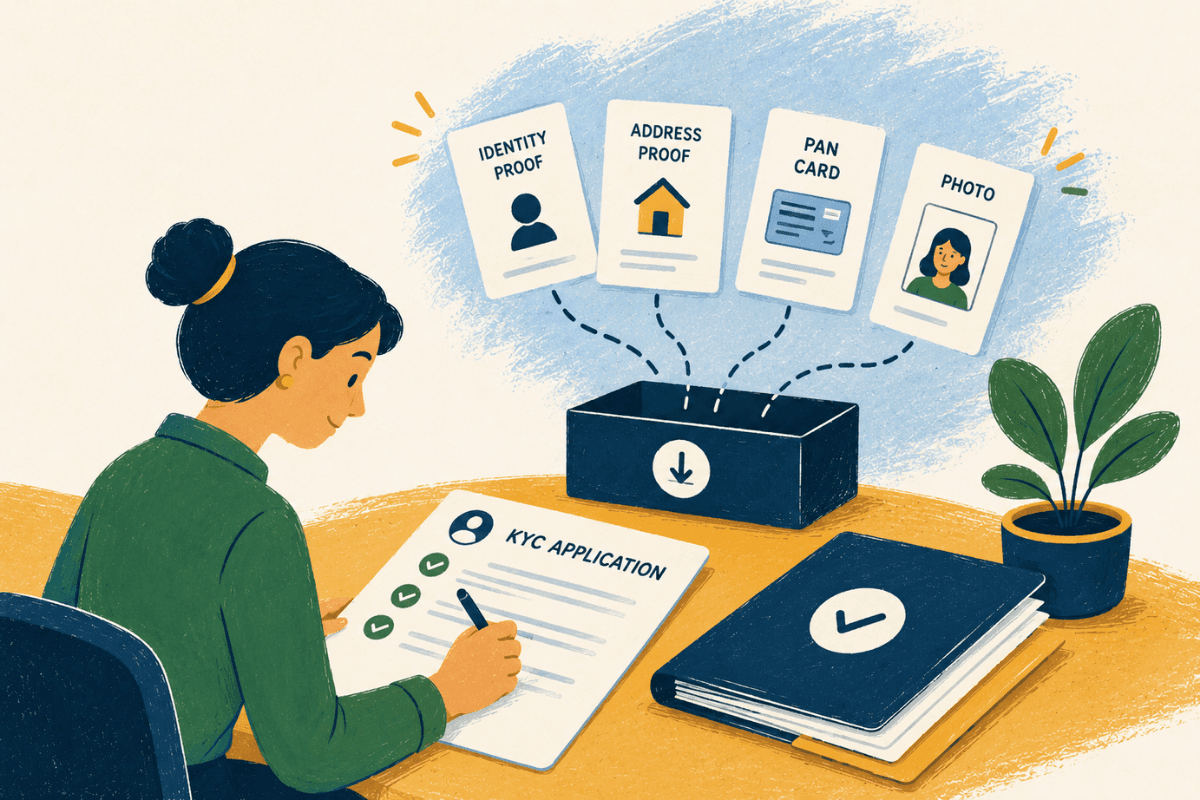
A KYC application for a bank account in India needs two things: an Officially Valid Document (OVD) proving your identity and address, and your PAN or Form 60.[1][4] You can submit these in person at a branch, or through an online channel that pairs document upload with a Video-based Customer Identification Process (V-CIP) call.[20]This piece covers which documents qualify, how to choose a submission channel, what happens after you submit, and how to check status or update KYC that’s already on file.
This process follows RBI’s Master Direction on KYC, originally issued 25 February 2016 and amended periodically since, most recently in 2025. It operationalises the KYC and customer due-diligence obligations set out in the Prevention of Money-Laundering Act, 2002 and the Prevention of Money-Laundering (Maintenance of Records) Rules, 2005.[24]
Which Documents You Need
RBI’s KYC Master Direction recognises a closed list of documents as OVDs for identity and address proof:
- •Aadhaar, including e-Aadhaar and m-Aadhaar
- •Passport
- •Voter's Identity Card (EPIC)
- •Driving Licence
- •NREGA job card, with state-government attestation
- •A letter issued by the National Population Register, containing name and address
[1]
For how Aadhaar itself gets checked as part of this process, see Aadhaar Verification: What It Is and How to Verify an Aadhaar Number.
Not every government-issued ID counts. HyperVerge’s explainer of the framework notes that “any government ID” doesn’t automatically qualify as an OVD: only documents on RBI’s specific list do. A college ID, for example, is government-issued but is not an OVD.[2]
If Your OVD Doesn’t Show Your Current Address
Where your primary OVD doesn’t carry your current address, RBI’s framework allows substitution with “deemed OVD” documents:
- •Utility bills (electricity, gas, or telephone), not more than two months old
- •A property or municipal tax receipt
- •A bank or post-office account statement
- •A Pension Payment Order (PPO)
- •An employer's accommodation-allotment letter
[3]
PAN, Form 60, and What Happens Without Either
Beyond the OVD, you also need to submit your Permanent Account Number (PAN), or the equivalent e-document, or Form No. 60 as defined under the Income-tax Rules, 1962, as part of customer due diligence.[4] Quoting PAN is itself a requirement under the Income Tax Act for opening a bank account; RBI’s KYC framework directs banks to obtain PAN or accept Form 60 in its place.[5]
If you have neither an Aadhaar (or Aadhaar enrolment) number nor a PAN and still want to open an account, banks are required to open a “small account” instead. That’s a limited-KYC account, and it can only be opened at branches linked to the bank’s core banking solution, or where the branch can manually monitor the account to ensure foreign remittances aren’t credited to it.[6]
Choosing How to Submit: Branch or Online
A first-time customer generally has two submission-channel choices.[20]
| In-Person (Branch) | Online (Digital + V-CIP) | |
|---|---|---|
| What It Involves | Physical document submission at a branch | Document upload plus a live Video-based Customer Identification Process (V-CIP) call, in which a bank official verifies the submitted ID document and captures a live photograph and location in real time |
| Typical Completion Time* | Approximately one week | 24–48 hours |
*Industry-reported estimates from a consumer-finance aggregator, not an RBI-mandated timeline. Exact timing varies by institution.[21][20]
For the regulatory distinction between eKYC and Digital KYC, including how Aadhaar OTP and biometric e-KYC modes work, see What Is eKYC? How Digital KYC Verification Works in India. That piece is the place to go for “aadhaar e kyc online” as a definitional question; here it’s just one path within the online channel above.
What Happens After You Submit
Once you submit your documents, the regulated entity’s typical process runs in this order.[22]
Document validation
Checking authenticity and running security checks on the submitted files.
Data extraction
Via OCR or manual entry, from the submitted documents.
Cross-verification
Checking the submitted details against government databases.
Account activation
Once verification clears.
Common Reasons a Submission Gets Delayed or Rejected
- •Blurry or low-resolution document scans
- •Poor lighting or glare obscuring document text
- •Expired documents
- •Mismatched name, date of birth, or address across the documents submitted
- •An address that doesn't match the bank's existing records
- •Submitting the wrong document type (for example, a proof-of-identity document where proof-of-address was required)
[23]
Updating Your KYC (Re-KYC)
RBI’s framework classifies customers into risk categories and sets a periodic KYC-update schedule accordingly:
| Risk Category | Minimum Re-KYC Frequency |
|---|---|
| High | Every 2 years |
| Medium | Every 8 years |
| Low | Every 10 years |
[7]
Under RBI’s 2025 amendment, low-risk customers whose periodic KYC is due get an extended window to complete it: one year from their KYC due date, or 30 June 2026, whichever is later. During this grace period the account stays under regular monitoring rather than being restricted.[8]
If Nothing About You Has Changed
Per RBI’s periodic-KYC-updation circular, referenced via its January 2023 instructions, if there’s no change in your KYC details, a self-declaration to that effect is enough to complete your periodic KYC update; no fresh documents required.[11]
Banks must offer this self-declaration route through non-face-to-face channels: registered email ID, registered mobile number, ATMs, digital channels (online or mobile banking), or letter, without requiring a branch visit.[12]
If Only Your Address Has Changed
Furnish the updated address through the same non-face-to-face channels listed above; the bank then verifies the declared address within two months.[13]
Before an Account Gets Restricted for Pending KYC
Under RBI’s 2025 amendment, banks must send at least three advance notifications, including at least one physical letter, before restricting an account for pending periodic KYC non-compliance.[14]Whether banks are authorised to restrict an account for pending periodic KYC in the first place is itself a live legal question, not a settled point; if you’re facing an actual restriction, get independent legal advice rather than relying on this summary of the notice requirement.
Business Correspondents and Dormant Accounts
Business Correspondents (BCs) are formally authorised to facilitate KYC updates through customer self-declaration and biometric e-KYC authentication. Inoperative or dormant accounts can be reactivated at any branch through V-CIP, or through an authorised BC.[15]
Checking Your KYC Status
Across Banks and Financial Institutions: CKYC
The Central KYC Registry (CKYC) is a centralised repository, maintained by CERSAI (Central Registry of Securitisation Asset Reconstruction and Security Interest of India), that holds a customer’s KYC records so they can be reused across participating financial institutions instead of repeating KYC at each one. On registration, the customer receives a 14-digit KYC Identification Number (KIN).[16] CKYC has been effective since 1 February 2017.[17]
For what CKYCRR stands for and how CERSAI operates the underlying registry, see CKYCRR Full Form: What It Means and Why It Matters in KYC.
For Mutual Funds and Securities: KRA
To check KYC status for participating in India’s securities market (mutual funds, for example), use a SEBI-registered KYC Registration Agency (KRA), such as CVL KRA, NSE KRA, or CAMS KRA, by entering your PAN. The result returns as one of four states: Verified, Pending, On Hold, or Rejected.[18] Once your KYC is verified through a KRA, you don’t need to repeat the process to invest with a different mutual fund house: the verification is shared across the KRA system.[19]
What This Means for Returning Customers and Onboarding Teams
The channel comparison above points to a practical decision rule rather than a single right answer. Use the online channel, document upload plus a V-CIP call, when speed matters and you can complete a live video verification: it’s reported to complete in 24–48 hours against roughly a week for branch-submitted KYC.[20][21] Use the branch route when handing over physical documents directly works better for you than a video call, or when the online setup isn’t available. The completion-time gap is an industry-reported estimate rather than a guarantee, so treat it as a planning input, not a fixed timeline.[21]
Two of the rules covered above also change what “KYC application” means once you’re already a KYC-verified customer, not a first-time one. Once your KYC record already exists in CKYC or has been verified through a KRA, it doesn’t need to be rebuilt from scratch: CKYC lets a participating institution retrieve your existing on-file KYC instead of collecting fresh documents, and a KRA-verified status carries across mutual fund houses without a repeat check.[16][19] At periodic re-KYC, a self-declaration closes the loop when nothing has changed, with no fresh documents required.[11] Read together, this suggests the full document-submission process described above in this piece is mainly a first-time, or changed-information, event: for a repeat or already-verified customer, most of what follows is a data-reuse or confirmation step rather than a new application. The same logic extends across institutions, not just within one: CKYC carries a customer’s on-file KYC to a new regulated entity,[16] and a KRA-verified status carries across mutual fund houses without a repeat check.[19]
Frequently Asked Questions
This piece summarises publicly available RBI material for informational purposes. It isn’t legal or compliance advice; confirm current document requirements, re-KYC timelines, and account-restriction procedures directly with your bank or against RBI’s current Master Direction before relying on them.
Bhanujeet Choudhary
Head of Compliance, KYCKART
Published August 15, 2026
KYCKART Intelligence
Turn Document Collection Into a Completed Onboarding File
KYCKART runs OVD checks, PAN verification, and V-CIP as one connected onboarding flow, so document collection doesn’t become the bottleneck between application and account activation. Speak with our team to see how it fits your stack.
Explore Onboarding Solutionsarrow_forward