Do seller and buyer identity match?
Verify Counterparty Identity
Confirm seller and buyer identity before asset intake. Under RBI KYC Directions for NBFCs, lenders run Aadhaar verification via OTP or XML and a PAN verification API lookup.
How dealers and auto lenders verify vehicle ownership, hypothecation status and blacklists through online RC checks, in seven steps.
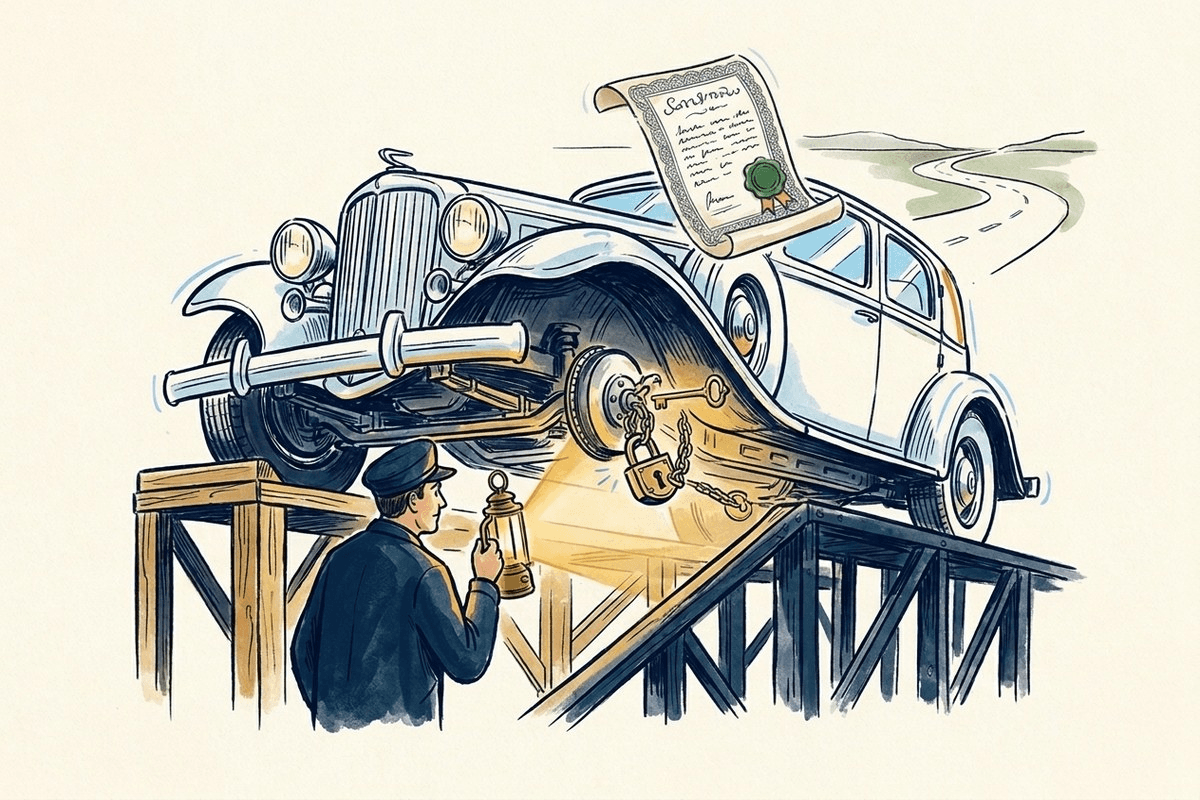
RC verification online lets used-car dealerships, fleet buyers, and auto lenders verify vehicle ownership, confirm registration status, and check active loans. By querying official transport records directly, businesses verify the legal owner, match engine numbers, spot police theft alerts, and confirm hypothecation status before paying money or funding a loan.
tips_and_updatesWhere things stand (October 2026)
14 / 45 / 30 days
Vehicle transfer notices follow statutory deadlines under Section 50 of the Motor Vehicles Act: 14 days intra-state, 45 days inter-state, and 30 days for buyers.
April 2023
The Ministry of Road Transport and Highways dealer rules, effective April 2023, shift vehicle custody and traffic liability to dealers upon filing Form 29C.
1 July 2024
Section 317 of the Bharatiya Nyaya Sanhita, 2023, in force since 1 July 2024, penalizes dealing in stolen vehicles.
The playbook
A compliant vehicle verification workflow validates counterparty identity, cross-matches asset identifiers, clears existing liens, and records title transfer across seven steps. Used-car dealerships, commercial fleet buyers, and auto lenders can run it to ensure clean collateral and compliant title transfers.
Pick a scenario to watch a vehicle move through the checks.StopHoldProceed
Vehicle presented for purchase or funding
Do seller and buyer identity match?
Confirm seller and buyer identity before asset intake. Under RBI KYC Directions for NBFCs, lenders run Aadhaar verification via OTP or XML and a PAN verification API lookup.
No
closeHalt the transactionAny identity mismatch
Is the RC active in VAHAN?
Call an authorized RC verification API using the registration number to fetch live registration status, vehicle class, fuel type, and emission standards from the central registry.
No
closeReject the assetRC inactive or suspended
Do owner name, VIN and engine match the record?
Match the seller’s name against the API record using phonetic matching. Per used-car documentation guidelines, inspect the 17-character stamped chassis VIN and engine block to detect vehicle cloning.
No
closeDecline and flagCloned or tampered vehicle
Is there a lien on the RC?
Check the hypothecation field. If a lien exists, hold funds until receiving an original loan closure letter, a 90-day lender NOC, and Form 35 under the Central Motor Vehicles Rules.
Yes
pauseHold disbursalUntil the loan closure letter, 90-day lender NOC and Form 35 are received
Re-check step 04, then continue
Any theft flag or pending challan?
Check state traffic systems and police theft records. Active theft FIRs or court challans freeze RTO processing. The seller must clear pending fines and furnish receipts before closing.
Stolen flag or FIR
closeReject immediatelyBNS Section 317
Pending challans
pauseHold closingSeller clears fines and furnishes receipts
Re-check step 05, then continue
Who is transferring the vehicle?
Submit transfer filings under Section 50 of the Motor Vehicles Act. For direct sales, file Form 29 and Form 30 within 14 days. For authorized dealers, submit electronic Form 29C on VAHAN under Rule 55B to shift custody liability.
Filing not yet digitised
pauseTrack RTO syncWhile filings are pending digitization
Re-check step 06, then continue
Is the audit trail archived and signed?
Save the API payload, inspection photos, and geolocated reports. Execute loan or purchase agreements via Aadhaar e-sign to build an admissible digital audit trail.
Physical registration cards fail to show live loan liens and police alerts, creating clear title and credit risks for buyers and lenders. A physical Registration Certificate (RC) card shows data frozen on its print date. It cannot reflect subsequent loan payoffs or new liens, leaving buyers and lenders vulnerable to competing claims.
Hidden liens
Under Section 51 of the Motor Vehicles Act, any financed vehicle must carry a lien endorsement in the VAHAN registry. Removing it requires a joint Form 35 filing under Rule 61 of the Central Motor Vehicles Rules, backed by a bank loan closure letter and a 90-day lender No Objection Certificate (NOC).
Double financing
An unreleased lien gives the prior lender senior priority. The secondary lender cannot register Form 34 or enforce security rights under SARFAESI without that release.
Criminal exposure
Under Section 317 of the Bharatiya Nyaya Sanhita, 2023, stolen property covers assets obtained through theft, robbery, breach of trust, or cheating. Receiving stolen property carries up to three years in prison and is non-bailable under the Bharatiya Nagarik Suraksha Sanhita, 2023 (BNSS), triable by a Magistrate. Habitual dealing is treated as a more serious offence and is triable by the Court of Session.
Automated blacklist checks prove commercial due diligence and absence of criminal intent.
Physical RC cards show only the status on their printing date, leaving lenders and dealers blind to post-issuance loan liens and police theft flags.
The public Parivahan portal offers basic masked searches for car owners, while commercial verification APIs supply unmasked, structured data for business systems.
The public portal
The Ministry of Road Transport and Highways runs citizen vehicle lookups on the Parivahan Sewa portal. The service requires mobile OTP login and visual CAPTCHAs, masking owner names and chassis digits for personal privacy. Portal terms ban automated scraping and bot queries, exposing unauthorized scrapers to IP blocks and Information Technology Act penalties.
The API route
Enterprise platforms connect via an authorized vehicle RC verification API linked to central transport databases, resolving queries in 800 to 2,500 milliseconds.
What comes back
An RC verification API response returns over 25 structured fields: unmasked owner names, chassis VINs, engine numbers, fuel types, emission standards, active RC status, financier details, road tax status, fitness validity, PUC expiry, and theft flags.
| Feature | lockPublic Parivahan Portal | boltCommercial RC Verification API |
|---|---|---|
| Access Mode | Citizen web portal login | Automated REST API integration |
| Owner Name | Masked (e.g., RAH** SHA*****) | Full unmasked legal name |
| Chassis & Engine | Partially masked digits | Complete 17-character VIN and engine number |
| Data Output | Web display only | Structured JSON payload (25+ attributes) |
| Latency | Manual lookup speed | 800 to 2,500 milliseconds |
| Encumbrance | Basic indicator | Full financier name and hypothecation details |
| Commercial Use | Scraping strictly prohibited | Authorized access via G2B gateways |
| Query Mode | Single query with OTP and CAPTCHA | Programmatic API queries |
Asset-backed auto lending and dealership operations require strict adherence to statutory transfer timelines, vehicle fitness standards, and traffic violation audits. Ownership transfer notices follow statutory deadlines under Section 50 of the Motor Vehicles Act:
Under dealer rules effective April 2023, the Form 29C filing shifts custody, traffic fine liability, and third-party risk to the dealer until resale. Dealerships must also log trip dates, drivers, mileage, purpose, and routes in an electronic trip register.
Traffic fines
Unpaid traffic fines attach to the vehicle registration number, not the driver. Buyers who acquire unchecked cars inherit liability for unpaid fines and court summons. Active police FIRs on CCTNS or unpaid challans freeze VAHAN processing, blocking transfer approvals.
Fitness
Commercial vehicles require a valid Certificate of Fitness under Section 56 of the Motor Vehicles Act.
Insurance
All vehicles must maintain third-party insurance under Section 146.
Vehicle age
Credit policies usually cap vehicle age at 10 to 12 years at maturity.
RTO sync lag
While VAHAN connects over 1,300 RTOs, paper filings in remote offices take 3 to 14 business days to appear on central servers. Verification platforms use dynamic polling to track pending application numbers during this window.
KYCKART provides automated vehicle verification infrastructure that connects directly with central transport registries to protect lenders and dealerships from title and fraud exposure. The KYCKART vehicle verification API links directly to authoritative VAHAN and e-challan gateways, returning structured vehicle data for use in your onboarding and collateral checks.
Lien detection
The platform provides automated lien detection, extracting active lender names to mitigate double-financing risk.
Theft and freezes
It checks national police databases and state traffic feeds to detect stolen vehicles and administrative freezes before deals close.
Physical cards
KYCKART uses optical character recognition for RC smart cards to parse card images and compare text against live records.
Audit trail
Lenders can pair verification with Aadhaar e-sign to build complete digital audit trails.
The practical implication is that manual RC checks and fragmented paperwork expose institutions to competing loan claims, administrative freezes, and criminal liability. Criminal liability applies under Section 317 of the Bharatiya Nyaya Sanhita. Senior lien priority applies under Section 51 of the Motor Vehicles Act. In addition, RTO database sync can lag by 3 to 14 business days.
Read together, these rules mean businesses cannot rely on physical paperwork alone. A physical card confirms only what was true on its print date. Paper slips offer no protection against police alerts or unresolved bank loans. This suggests three operational priorities for risk teams:
Screen in real time.
Require real-time API screening to verify active loan status before approval. Demand original loan closure letters, 90-day lender NOCs, and Form 35 filings for encumbered cars.
See step 04arrow_upwardPair digital with physical.
Pair digital database checks with physical asset inspection. Use phonetic matching for owner names and inspect the stamped 17-character chassis VIN to detect vehicle cloning.
See step 03arrow_upwardPoll during RTO lag.
Set up automated polling to track pending RTO applications during the 3 to 14 business day sync window until the new RC issues.
See step 06arrow_upwardThe practical implication is that automated verification workflows reduce fraud exposure, speed up transactions, and maintain clean legal compliance across vehicle portfolios.
Bhanujeet Choudhary
Head of Compliance, KYCKART
Published October 28, 2026
Disclaimer: This article provides regulatory and operational analysis for informational purposes. It does not constitute legal, regulatory, tax, or compliance advice. Readers should review applicable transport rules, Reserve Bank of India directions, and legal counsel guidance for their specific institution.
KYCKART Intelligence
Talk to our team about adding RC, lien and theft-flag checks to your auto-lending or used-car workflow.
Talk to Our Team About Vehicle Verificationarrow_forward