Udyam Certificate: What Lenders Need to Verify Before Approving an MSME Loan
What banks, NBFCs, and fintech lenders must verify on an Udyam Certificate: dynamic QR code authenticity, PAN/GSTIN triangulation, and PSL eligibility rules.
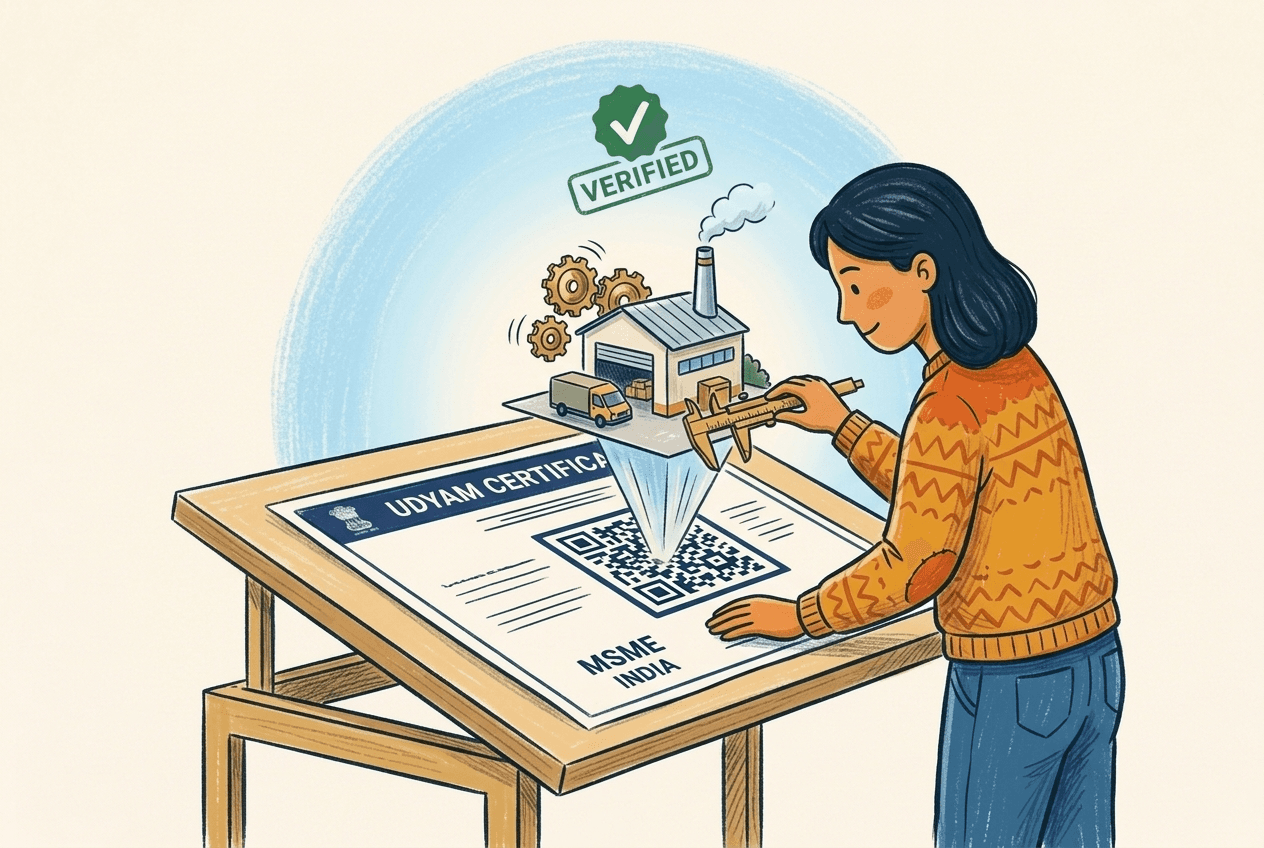
An Udyam Registration Certificate proves that a business is officially recognized as a Micro, Small, or Medium Enterprise by the Ministry of Micro, Small and Medium Enterprises. For banks, NBFCs, and fintech lenders evaluating an MSME credit application, verifying this certificate confirms whether the borrower qualifies for Priority Sector Lending quotas, determines eligibility for collateral-free credit guarantees, and authenticates operational business existence. Lenders must never rely on a submitted PDF copy at face value; verifying the certificate requires validating its live status on the government database, scanning its dynamic QR code, and triangulating its contents against PAN, GSTIN, and banking records.
Anatomy of an Udyam Certificate: What Underwriters Must Check
Administered under the MSMED Act, 2006 and Gazette Notification S.O. 2119(E), Udyam Registration replaced legacy self-declared registrations with an integrated, verified registry. A genuine certificate contains specific operational data points that credit underwriters must inspect against loan documentation:
| Certificate Field | Printed on Genuine Certificate | Underwriting Cross-Check |
|---|---|---|
| Udyam Registration Number (URN) | 16-character identifier formatted as UDYAM-State-District-7 Digits | Validate live registration status via official government verification records. |
| Name of Enterprise | Legal registered name of the business entity | Cross-match with PAN verification and the business name on operative bank statements. |
| Type of Enterprise | Micro, Small, or Medium classification | Verify that investment and turnover align with the March 2025 Gazette Notification thresholds. |
| Major Activity | Primary business operations: Manufacturing or Services | Compare against stated business activity and declared working capital usage. |
| Date of Commencement | Date of Commencement of Production / Business | Compare with vintage claimed in loan application to detect vintage inflation. |
| Units / Plant Locations | Physical addresses of all operational manufacturing units/plants | Verify against physical Field Investigation (FI) reports and property utility bills. |
| National Industry Classification (NIC) | 2-digit, 4-digit, and 5-digit NIC activity codes | Screen for eligible MSME activities and verify PSL qualification rules. |
| District Industries Centre (DIC) | Listed District Industries Centre of jurisdiction | Confirm territorial alignment with registered operational locations. |
| Dynamic QR Code | Embedded scannable code on the certificate face | Scan to ensure the decoded URL redirects to the official government portal. |
Unlike the earlier Udyog Aadhaar regime, which allowed applicants to self-declare numbers without documentary verification, Udyam Registration is integrated directly with the Income Tax and GST databases. Financial figures for investment and turnover are pulled directly from tax filings, replacing self-reported borrower numbers.
Three Critical Verification Red Flags for Credit Teams
1. The Dynamic QR Code Trap
Every authentic Udyam Registration Certificate contains an embedded dynamic QR code. When scanned with any standard mobile camera or scanner, this QR code must resolve directly to the official government portal domain (udyamregistration.gov.in) and display the live enterprise profile.
Underwriters encounter three distinct manipulation patterns on forged certificates:
- •Static or Dead QR Codes: Fraudulent certificates often contain a static image or dummy code that fails to scan.
- •Spoofed Phishing Domains: The QR code resolves to a commercial look-alike URL (using .com, .org, or .in suffixes) designed to simulate government confirmation screens.
- •Cloned QR Codes: The applicant pastes a genuine QR code copied from an unrelated business onto their forged certificate. Scanning the code immediately surfaces a different enterprise name, URN, or state jurisdiction.
2. Inactive, Suspended, or Cancelled Status
A borrower presenting a genuine PDF certificate printed a year ago may no longer hold active MSME registration. The Ministry of MSME can suspend or cancel registrations if an enterprise fails to fulfill mandatory annual tax updates or if regulatory authorities detect fraudulent submissions.
Underwriters must verify that the enterprise holds an active registration status at the time of credit evaluation. Approving credit against a cancelled certificate exposes the institution to regulatory classification loss.
3. Identity and Operational Triangulation
Loan origination teams must cross-check the Udyam record across three complementary enterprise data rails:
- •PAN Consistency: The PAN linked to the URN must match the applicant. For proprietorships, this is the individual proprietor’s PAN; for partnerships, companies, and LLPs, it is the entity’s commercial PAN.
- •GSTIN Reconciliation: If the enterprise has registered GSTINs, these must be reconciled against active GST records to ensure turnover and operating branches align with the Udyam filing.
- •Bank Account Matching: The legal name recorded on the certificate must match the account holder name confirmed through bank account verification.
- •Business Vintage: The “Date of Commencement of Production/Business” printed on the certificate serves as an objective anchor. If a loan application claims seven years of successful trading, but the Udyam certificate lists production commencing six months ago, underwriters must investigate the discrepancy.
MSME Classification, PSL Sub-Targets, and NIC Code Rules
Verifying an Udyam certificate is necessary because loan classification impacts balance sheet compliance and capital allocation for regulated lenders.
Enterprise Classification Thresholds
Under Gazette Notification S.O. 1364(E), dated 21 March 2025, the Ministry of MSME established the following statutory classification thresholds:
| Category | Investment (Plant & Machinery) | Annual Turnover |
|---|---|---|
| Micro | Up to ₹2.5 crore | Up to ₹10 crore |
| Small | Up to ₹25 crore | Up to ₹100 crore |
| Medium | Up to ₹125 crore | Up to ₹500 crore |
Per RBI’s Master Direction on Priority Sector Lending, domestic commercial banks and foreign banks with 20 or more branches must meet a mandatory sub-target of 7.5% of Adjusted Net Bank Credit (ANBC) or Credit Equivalent of Off-Balance Sheet Exposure (CEOBE) specifically for lending to Micro enterprises. Correct classification on the Udyam certificate determines whether a loan asset qualifies toward this 7.5% sub-target. Under RBI Circular FIDD.MSME & NFS.BC.No.4/06.02.31/2020-21, RBI directed all commercial banks, cooperative banks, financial institutions, and NBFCs to obtain the Udyam Registration Certificate to classify loans under MSME categories.
The Retail and Wholesale Trade Limitation
“Under RBI Circular FIDD.MSME & NFS.BC.No.13/06.02.31/2021-22, retail and wholesale traders qualify as MSMEs strictly for the limited purpose of Priority Sector Lending, but remain excluded from non-lending MSME manufacturing subsidies.”
In July 2021, the government permitted retail and wholesale traders to register on the Udyam portal under three specific National Industry Classification codes:
- •NIC 45: Wholesale and retail trade and repair of motor vehicles and motorcycles
- •NIC 46: Wholesale trade, except of motor vehicles and motorcycles
- •NIC 47: Retail trade, except of motor vehicles and motorcycles
RBI Circular FIDD.MSME & NFS.BC.No.13/06.02.31/2021-22 clarified that while credit facilities extended to these traders qualify for PSL classification, their MSME status is strictly limited to priority sector credit benefits. Underwriters must note that trading enterprises holding these NIC codes cannot access broader manufacturing incentives or non-lending central subsidies.
Informal Micro Enterprises and the Udyam Assist Platform
Many informal micro businesses operate without formal PAN or GSTIN documentation. To bring these enterprises into formal credit channels, SIDBI launched the Udyam Assist Platform (UAP).
Under RBI Circular FIDD.MSME & NFS.BC.No.09/06.02.31/2023-24, dated 9 May 2023, the Reserve Bank directed that Udyam Assist Certificates (UAC) issued to informal micro enterprises through designated agencies are treated at par with standard Udyam Registration Certificates for PSL classification. Lenders evaluating micro borrowers without GSTIN can accept the UAC for PSL compliance.
Furthermore, holding a verified Udyam certificate is a mandatory prerequisite for borrowers seeking collateral-free credit under the Credit Guarantee Fund Trust for Micro and Small Enterprises(CGTMSE), which guarantees loans up to ₹5 crore for eligible Micro and Small enterprises.
Manual Portal Lookup vs. Automated API Verification
Underwriting teams can verify an Udyam certificate through two operational approaches.
Manual Portal Verification
Underwriters can access the Ministry of MSME’s verification utility directly:
Navigate to the official portal at udyamregistration.gov.in.
Open the “Print/Verify” dropdown and select “Verify Udyam Registration Number.”
Enter the 16-character Udyam Registration Number and solve the security captcha.
Review the official registration details displayed on the government screen.
While effective for occasional single-file checks, manual lookups require manual data entry, human scrutiny of complex NIC codes, and screen capture storage, creating operational friction during peak loan volumes.
Automated API Verification
To streamline underwriting, digital lenders, banks, and NBFCs integrate automated Udyam verification APIs into their loan origination systems (LOS).
Verification APIs connect directly to official government repositories to retrieve structured verification payloads in real time:
- •Real-time validation of registration status (Active vs. Inactive)
- •Structured extraction of enterprise name, enterprise type, and major activity
- •Comprehensive lists of all registered manufacturing units and plant addresses
- •Complete 2-digit, 4-digit, and 5-digit NIC codes for automated PSL rule-engine screening
- •Full compliance with the Digital Personal Data Protection (DPDP) Act through consent-driven verification workflows
Automated verification converts an error-prone document inspection into a structured data check, preventing forged PDFs from slipping through underwriting queues.
What This Means for MSME Lending Operations
Read together, RBI’s priority lending mandates, the dynamic QR structure, and the multi-database integration of Udyam point to three practical implications for credit risk and compliance teams.
First, the practical implication of RBI’s 7.5% Micro-enterprise PSL quota is that enterprise classification is a balance-sheet governance issue, not just a borrower qualification check. If an underwriter accepts an unverified or outdated certificate where a borrower has crossed the ₹10 crore turnover threshold into Small classification, the bank risks misallocating the loan asset against its Micro sub-target. Because Udyam classification updates automatically based on annual tax filings, lenders must verify the live status of the certificate at loan renewal and annual review, ensuring credit teams do not rely on static records collected at initial onboarding.
Second, the structural shift from self-declared Udyog Aadhaar to tax-linked Udyam means that the certificate acts as a gateway for multi-source verification. When underwriters extract the URN and its linked PAN, GSTIN, and plant addresses, they obtain an objective baseline to validate against collateral inspections, bank account records, and GST filings. A discrepancy between the declared operating units on Udyam and the physical inspection address is one of the clearest early indicators of shell entities or loan diversion.
Finally, while incumbent bank content such as Kotak Mahindra Bank’s explainer emphasizes borrower incentives like CGTMSE guarantees and delayed payment protections, lenders must treat the document primarily as a compliance and fraud control. Screening NIC codes against PSL exclusions (particularly ensuring retail and wholesale traders under NIC 45, 46, and 47 are restricted to PSL credit and not routed into ineligible subsidy schemes) protects lending institutions from regulatory audit penalties.
How KYCKART Helps
KYCKART verifies Udyam Registration alongside PAN, GSTIN, and bank account records in a single onboarding workflow, so a certificate’s QR code authenticity, live status, and PSL classification are checked automatically rather than trusted at face value.
Frequently Asked Questions
Bhanujeet Choudhary
Head of Compliance, KYCKART
Published September 17, 2026
Disclaimer: This article is for informational purposes only and does not constitute legal, tax, or regulatory compliance advice. Lending institutions should consult official Reserve Bank of India Master Directions, Ministry of MSME notifications, and their internal compliance counsel before establishing underwriting credit policies.
KYCKART Intelligence
Stop Trusting a PDF at Face Value
KYCKART checks a submitted Udyam certificate’s live status, QR code, and PAN/GSTIN alignment automatically, so forged or outdated certificates don’t slip through underwriting.
See How KYCKART Verifies Onboarding Documentsarrow_forward